Statistics and machine learning
Explainability, fairness, and challenger models
Assess model outputs and impacts across groups while preserving a clear purpose and review trail.
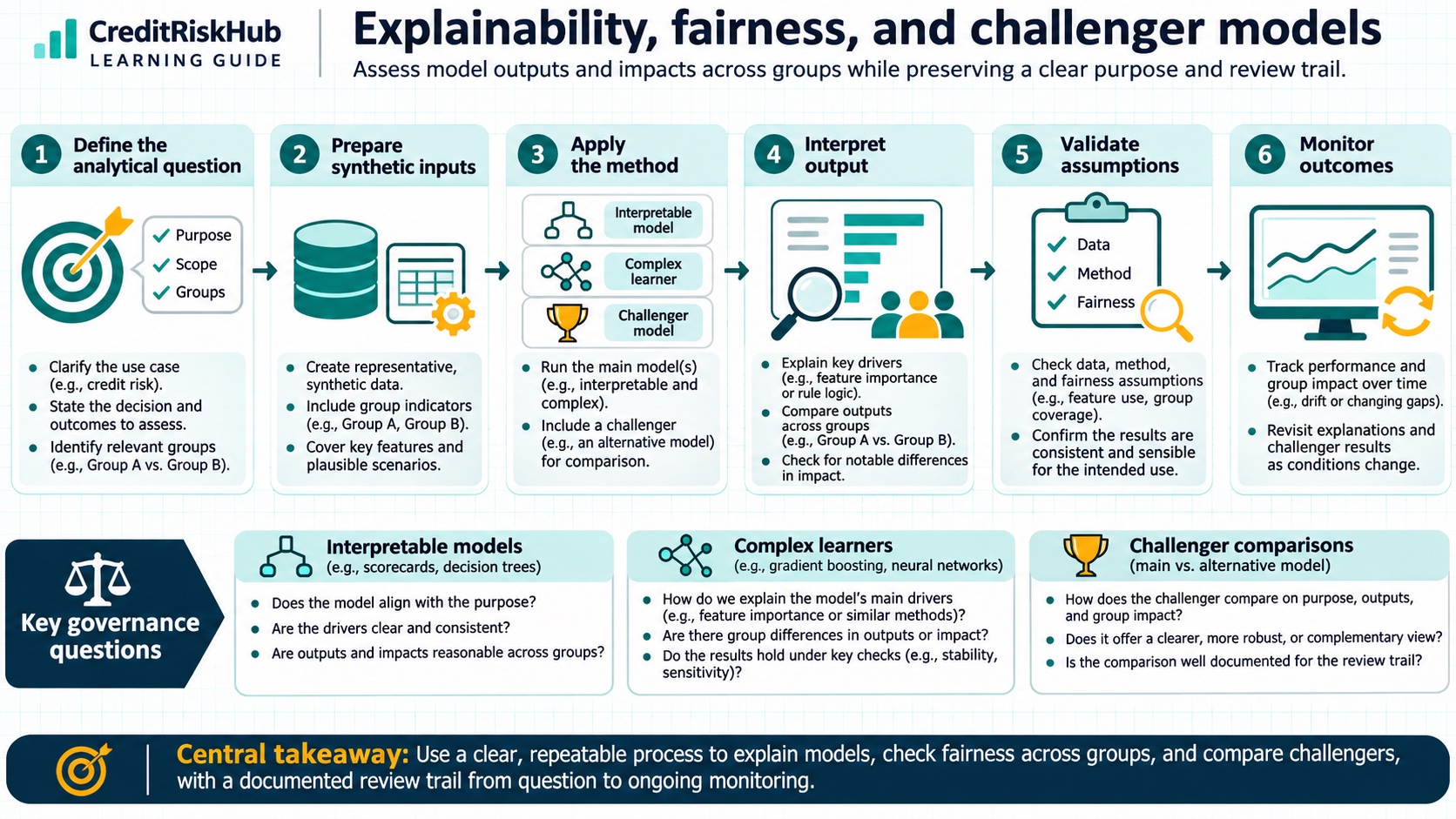
Purpose
Outline governance questions for interpretable models, complex learners, and challenger comparisons.
Key terms
Hover over or focus a term for a quick definition, or open its glossary entry.
Key definitions
- Explainability describes how inputs relate to model output in a form suitable for the intended audience.
- A challenger is a comparison model used to test the incumbent or explore alternatives.
A challenger comparison should align target, population, time period, and decision threshold before comparing outputs.Worked example
Compare approval and error rates by relevant segments, then investigate differences in data, calibration, policy, and customer impacts rather than relying on one summary ratio.
Detailed explanation
Complex models can improve predictive fit while increasing explanation and control demands. Use global and local explanation tools as diagnostics, then verify that explanations are stable, faithful to the model, and suitable for the decision context. A feature importance score alone does not show causal effect.
Test model performance and outcomes by relevant product, geography, and customer groups where lawful and appropriate. Examine selection, missingness, calibration, error rates, and threshold effects. Maintain a simpler challenger and document why an incumbent remains appropriate. OSFI's model-risk guidance emphasizes lifecycle governance and risk-proportionate oversight for federally regulated institutions; applicability depends on scope and effective dates.
Try a reproducible Python example
These examples use synthetic inputs and run locally in a browser worker. Edit the code, run it, and compare its output with the published example.
Runnable Python · local in your browser
Calculate WOE and IV from grouped counts
Use synthetic good and bad counts for three ordered scorecard bins. The 0.5 adjustment avoids a zero distribution in this small example.
Output
Run the code to see the output.
Runtime loads only after you press Run. Code runs in a separate browser worker with a 10-second limit and a 20,000-character output cap. Use synthetic examples only; browser execution is not a secure environment for secrets or sensitive records.
Runnable Python · local in your browser
Convert a logistic model logit to PD
Apply the logistic function to an illustrative intercept plus two feature contributions.
Output
Run the code to see the output.
Runtime loads only after you press Run. Code runs in a separate browser worker with a 10-second limit and a 20,000-character output cap. Use synthetic examples only; browser execution is not a secure environment for secrets or sensitive records.
Assumptions
- Group definitions, legal obligations, and customer-impact analysis are determined for the jurisdiction and use case.
Limitations
- Feature attribution is not proof of causality or fairness.
- Protected attributes and proxies require careful legal and governance treatment.
References
- Guideline E-23: Model Risk Management — Office of the Superintendent of Financial Institutions Canada
- Metrics and scoring: quantifying the quality of predictions — scikit-learn documentation
Educational material only. Methods and examples are simplified; state and validate the assumptions required for your use case.