Credit scorecards
Binning, Weight of Evidence, and Information Value
Calculate bin-level evidence while guarding against unstable or empty bins.
Purpose
Explain how bins summarize predictor relationships with a binary outcome in a logistic scorecard.
Key terms
Hover over or focus a term for a quick definition, or open its glossary entry.
Key definitions
- Weight of Evidence (WOE) compares the share of goods and bads in a bin.
- Information Value (IV) aggregates bin separation; conventions vary with the chosen good/bad sign.
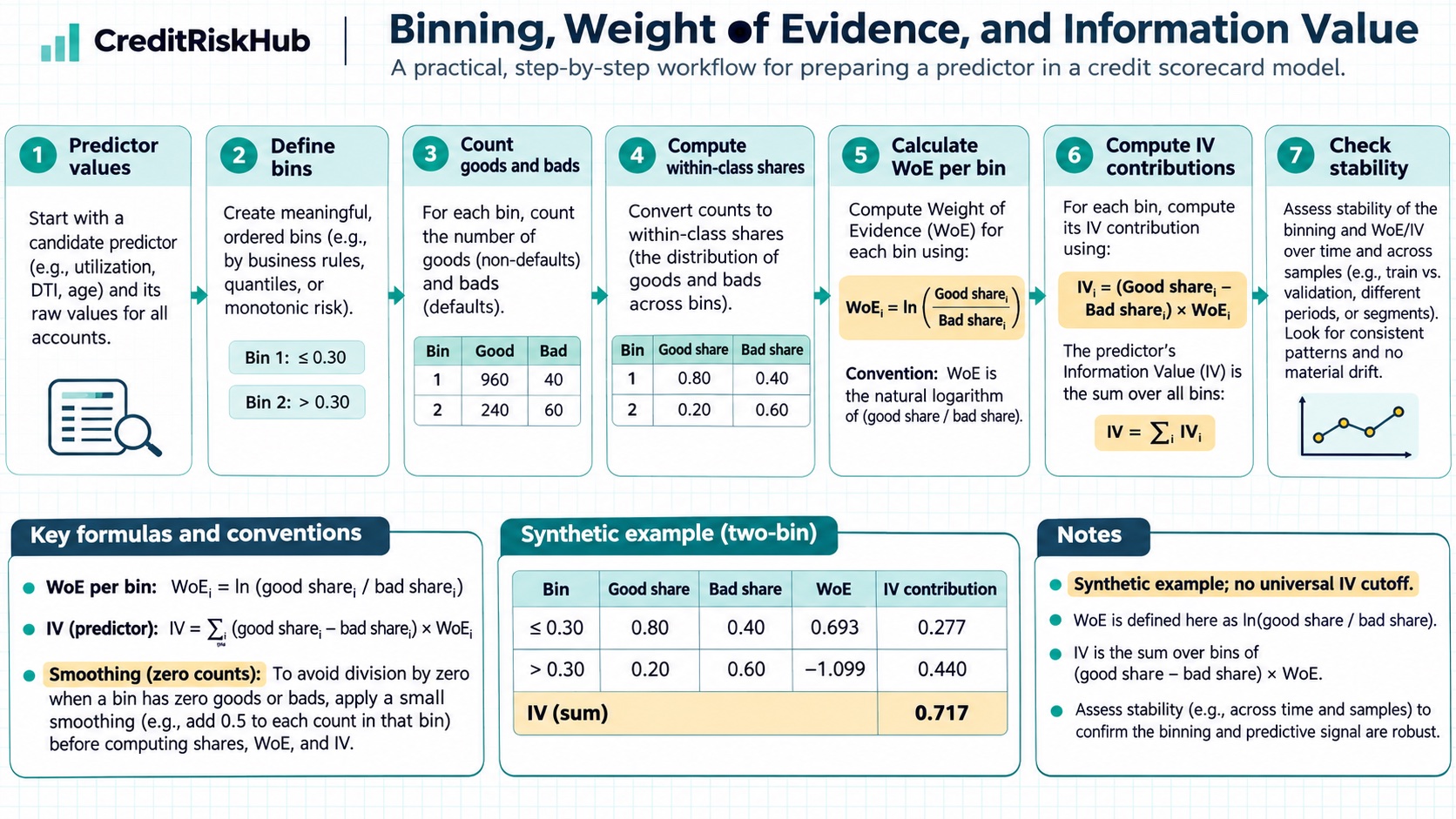
WOEᵢ = ln(good_shareᵢ ÷ bad_shareᵢ); IV = Σᵢ(good_shareᵢ − bad_shareᵢ) × WOEᵢ.Worked example
If a bin contains 30% of goods and 10% of bads, WOE = ln(3) ≈ 1.099 under this convention.
Detailed explanation
Binning creates interpretable groups for continuous or categorical variables. For each bin, count good and bad outcomes, compute each class share, and take the logarithm of the share ratio. This page defines positive WOE as good-heavy; reversing the ratio reverses the sign but not the underlying evidence. A small smoothing adjustment can prevent undefined logarithms when one class has zero observations.
IV sums the difference in class shares multiplied by WOE. Treat it as a development diagnostic, not a universal variable-selection threshold. Check sample size, monotonicity where justified, missing-value bins, stability over time, business meaning, and leakage. Fit bin boundaries on training data only and preserve them for validation and production scoring.
Try a reproducible Python example
These examples use synthetic inputs and run locally in a browser worker. Edit the code, run it, and compare its output with the published example.
Runnable Python · local in your browser
Calculate WOE and IV from grouped counts
Use synthetic good and bad counts for three ordered scorecard bins. The 0.5 adjustment avoids a zero distribution in this small example.
Output
Run the code to see the output.
Runtime loads only after you press Run. Code runs in a separate browser worker with a 10-second limit and a 20,000-character output cap. Use synthetic examples only; browser execution is not a secure environment for secrets or sensitive records.
Assumptions
- Bins are defined without using future information, and smoothing is disclosed for zero counts.
Limitations
- IV is a screening statistic, not proof of causality or out-of-time performance.
- Automated bins can overfit, be unstable, or encode sensitive proxies.
References
- Guidelines on PD estimation, LGD estimation and treatment of defaulted assets — European Banking Authority
- Metrics and scoring: quantifying the quality of predictions — scikit-learn documentation
Educational material only. Methods and examples are simplified; state and validate the assumptions required for your use case.