Credit scorecards
Logistic regression and score scaling
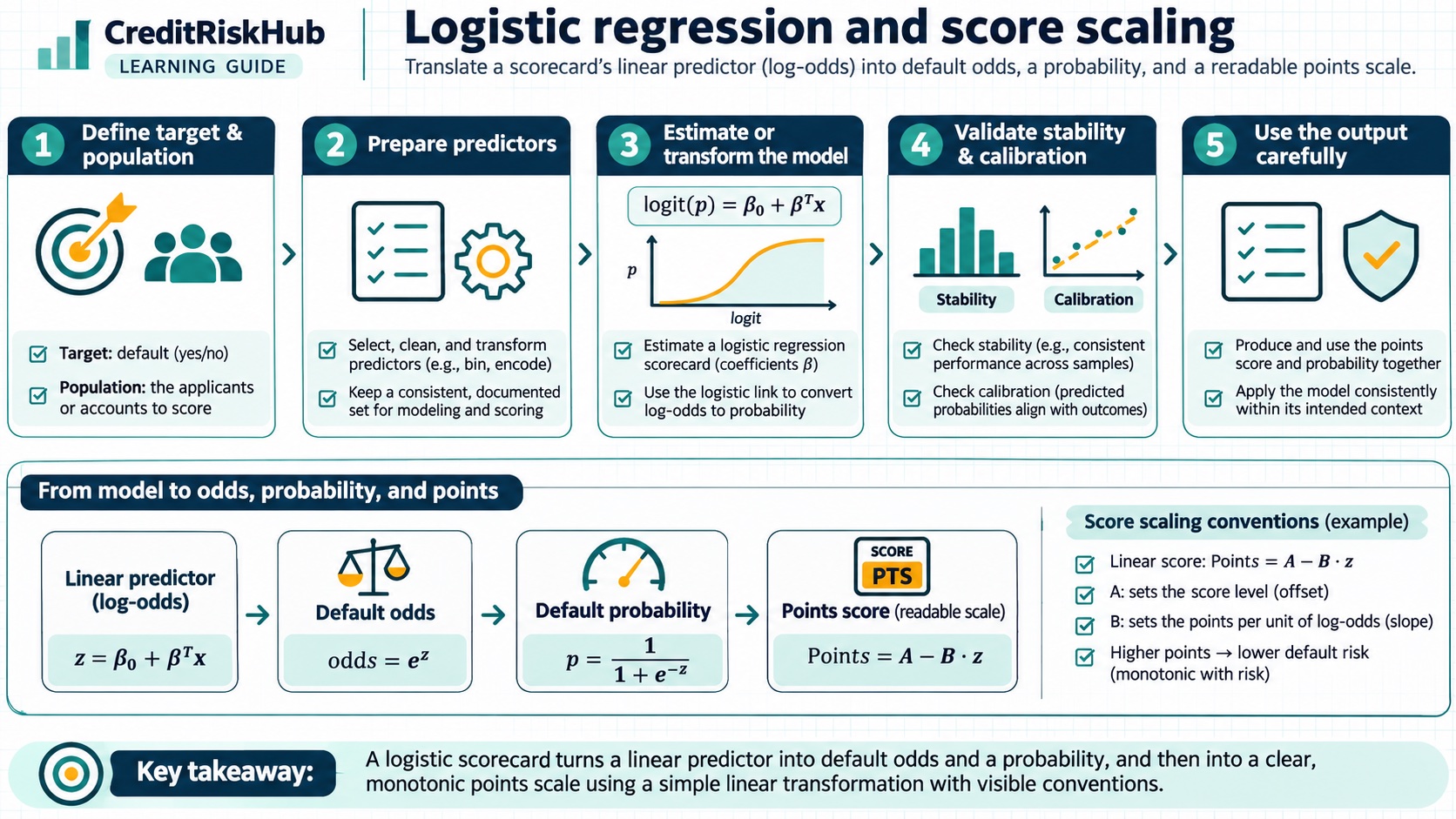
Translate model log-odds into probabilities and a points scale with visible conventions.
Purpose
Connect a logistic scorecard's linear predictor to default odds and a readable points scale.
Key terms
Hover over or focus a term for a quick definition, or open its glossary entry.
Key definitions
- The logistic link maps a linear predictor to a probability between zero and one.
- Points scaling is a linear transform of log-odds, with the sign chosen so higher points mean lower risk if desired.
PD = 1/(1 + e^(−η)); factor = PDO/ln(2); score = base_score − factor × ln(default_odds/base_odds).Worked example
For η = −3, PD ≈ 4.74%; doubling odds shifts points by the configured PDO under this orientation.
Detailed explanation
Logistic regression models the log-odds of the selected target as a linear combination of predictors. The inverse-logit produces probabilities, subject to sampling, specification, and calibration limitations. A scorecard can convert this log-odds quantity into points so that users can read relative changes on an additive scale.
Before publishing points, write down whether odds mean good-to-bad or bad-to-good, whether high scores mean low or high risk, the chosen base score, base odds, and PDO. Test the conversion with a worked example and ensure it reverses consistently. Scaling does not repair a mis-specified model, a non-representative sample, or a probability estimate that is poorly calibrated to the current population.
Try a reproducible Python example
These examples use synthetic inputs and run locally in a browser worker. Edit the code, run it, and compare its output with the published example.
Runnable Python · local in your browser
Calculate WOE and IV from grouped counts
Use synthetic good and bad counts for three ordered scorecard bins. The 0.5 adjustment avoids a zero distribution in this small example.
Output
Run the code to see the output.
Runtime loads only after you press Run. Code runs in a separate browser worker with a 10-second limit and a 20,000-character output cap. Use synthetic examples only; browser execution is not a secure environment for secrets or sensitive records.
Assumptions
- The base score, base odds, and points-to-double-odds (PDO) direction are stated.
Limitations
- Scaling changes presentation, not model ranking or calibration.
- A score is not a PD until its mapping and target population are defined.
References
- Probability calibration — scikit-learn documentation
- Guidelines on PD estimation, LGD estimation and treatment of defaulted assets — European Banking Authority
Educational material only. Methods and examples are simplified; state and validate the assumptions required for your use case.