Credit scorecards
A credit scorecard development blueprint
Design the sample, target, predictors, score scale, validation, and decision use as one workflow.
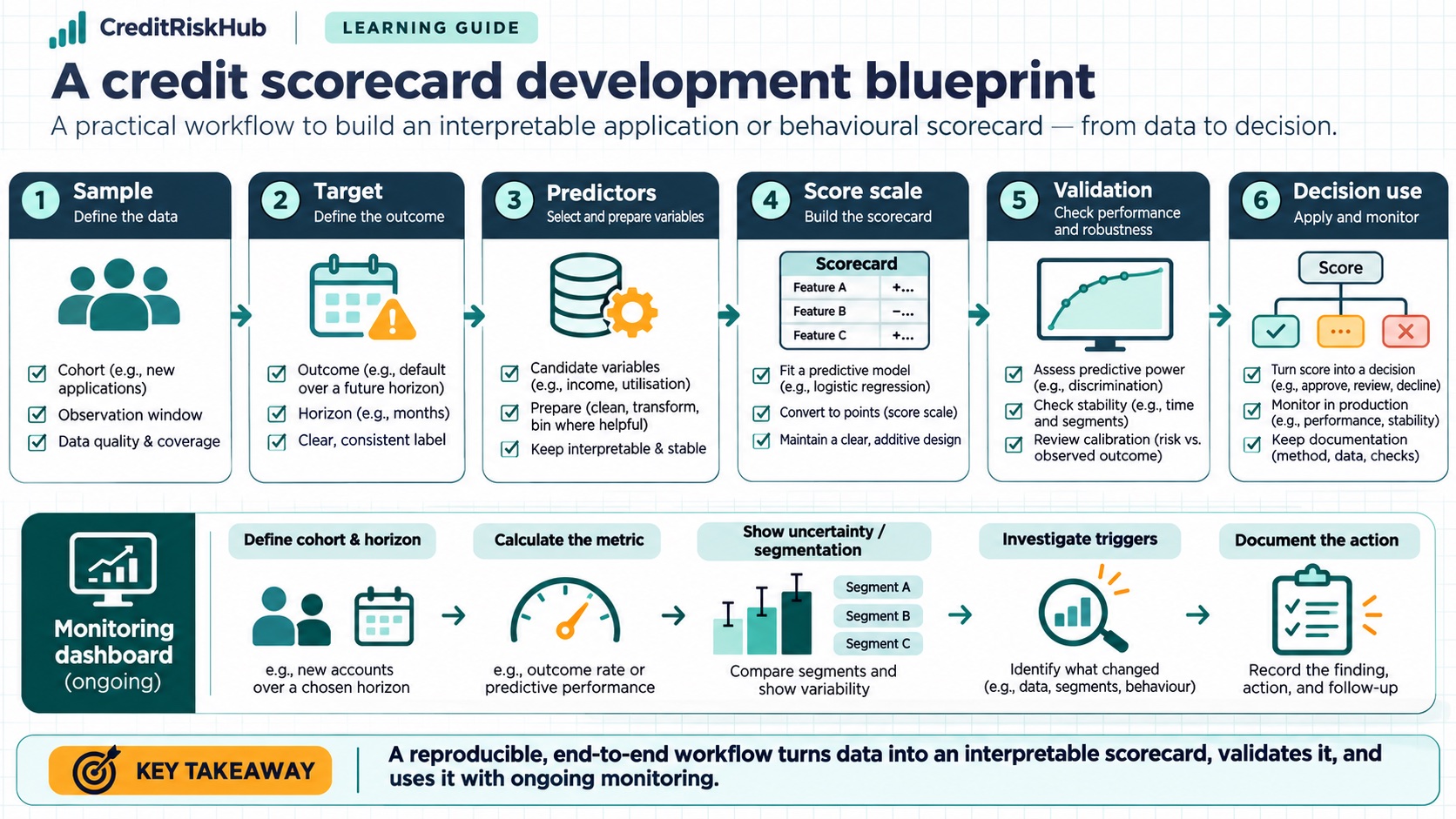
Purpose
Give a reproducible sequence for building an interpretable application or behavioural scorecard.
Key terms
Hover over or focus a term for a quick definition, or open its glossary entry.
Key definitions
- A scorecard maps defined customer or account attributes to a risk score or probability.
- Development sample and target definition determine what the score can learn.
Logistic scorecard: logit(P(default)) = β₀ + Σⱼ βⱼxⱼ.Worked example
A development record might contain application-time income band, utilization, and bureau history, with a 12-month target defined from an approved default rule.
Detailed explanation
Start with intended use, eligibility population, unit of analysis, default event, observation date, and performance window. Freeze a point-in-time feature snapshot before label construction. Explore data quality, bin continuous and categorical predictors, assess directional behavior, fit a transparent baseline, scale points if needed, and validate on later or otherwise independent observations.
Set cut-offs only after considering business costs, policy constraints, fairness, and capacity. Document missing-value handling, overrides, exclusions, and score-to-PD calibration. A scorecard is a governed decision component; performance monitoring and change control are part of its design, not an afterthought.
Try a reproducible Python example
These examples use synthetic inputs and run locally in a browser worker. Edit the code, run it, and compare its output with the published example.
Runnable Python · local in your browser
Calculate WOE and IV from grouped counts
Use synthetic good and bad counts for three ordered scorecard bins. The 0.5 adjustment avoids a zero distribution in this small example.
Output
Run the code to see the output.
Runtime loads only after you press Run. Code runs in a separate browser worker with a 10-second limit and a 20,000-character output cap. Use synthetic examples only; browser execution is not a secure environment for secrets or sensitive records.
Assumptions
- The target is observable over a justified performance window and features are available at scoring time.
Limitations
- A technically accurate model may still be unsuitable for a decision or population.
- Rejects and missing outcomes can create sample-selection bias.
References
- Guidelines on PD estimation, LGD estimation and treatment of defaulted assets — European Banking Authority
- Guideline E-23: Model Risk Management — Office of the Superintendent of Financial Institutions Canada
Educational material only. Methods and examples are simplified; state and validate the assumptions required for your use case.