Credit scorecards
Cut-offs, overrides, and reject inference
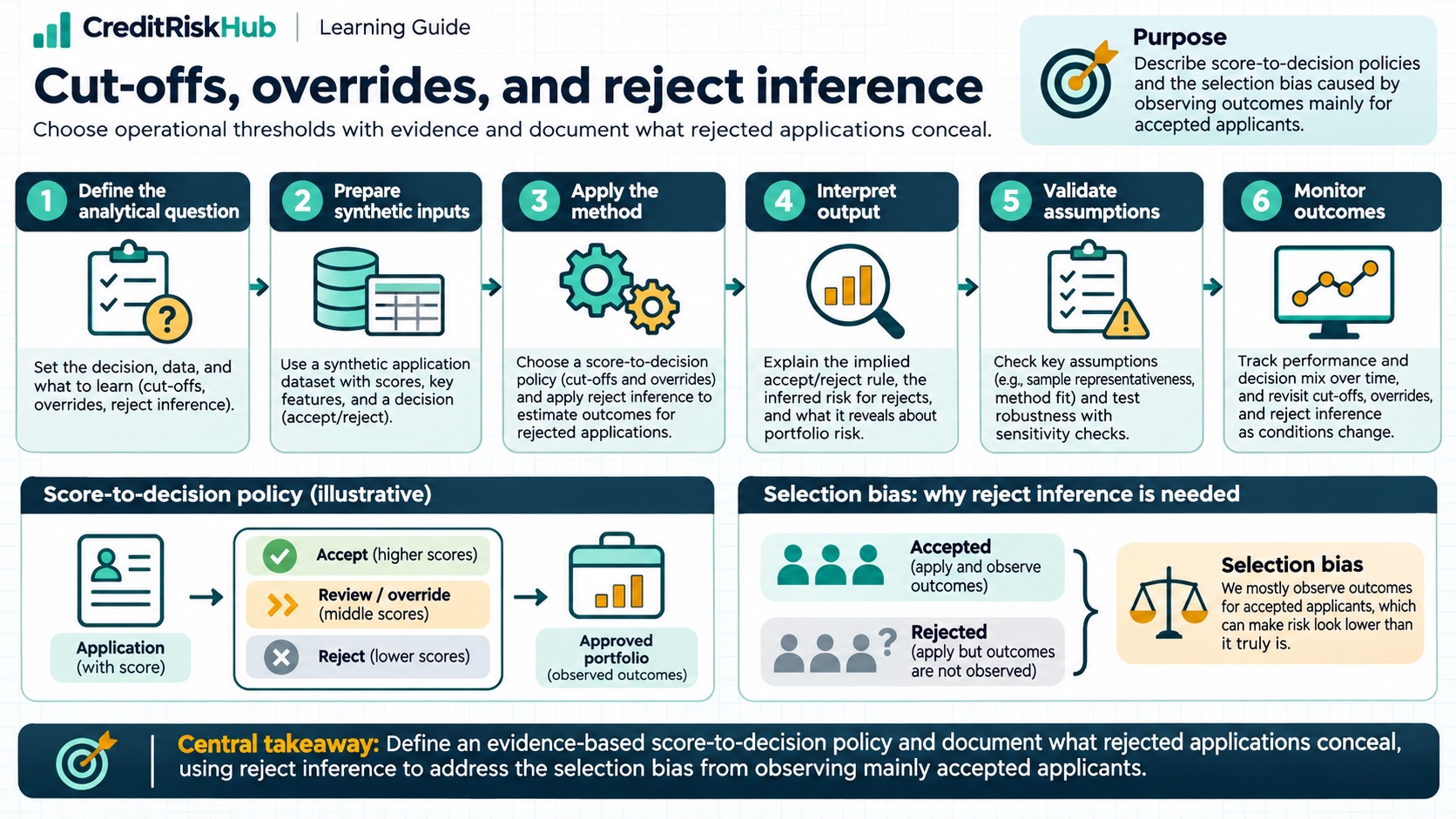
Choose operational thresholds with evidence and document what rejected applications conceal.
Purpose
Describe score-to-decision policies and the selection bias caused by observing outcomes mainly for accepted applicants.
Key terms
Hover over or focus a term for a quick definition, or open its glossary entry.
Key definitions
- A cut-off is a decision boundary applied to a score or estimated risk.
- Reject inference refers to methods used to reason about outcomes for applicants denied credit, whose repayment outcomes are unobserved.
Expected decision value = Σᵢ P(outcomeᵢ | applicant) × value(outcomeᵢ), using an explicit policy objective.Worked example
If a lender approves only applicants above a score boundary, observed repayment data do not directly reveal how denied applicants would have performed.
Detailed explanation
A cut-off turns a ranking or PD into an action. The appropriate threshold depends on exposure, expected returns, loss severity, operating costs, regulation, affordability policy, and risk appetite. Analyze alternatives as policy scenarios; do not present one threshold as universally optimal. Track manual overrides, override reasons, approvals, declines, and subsequent outcomes.
Because outcomes are usually observed for booked accounts, the development sample is selected by previous policy. Reject-inference techniques may reweight, augment, or otherwise estimate outcomes for declined applications, but the unobserved labels mean results depend on assumptions. Keep reject-inference estimates separate from observed outcomes, test sensitivity to assumptions, and explain the limits to decision-makers.
Try a reproducible Python example
These examples use synthetic inputs and run locally in a browser worker. Edit the code, run it, and compare its output with the published example.
Runnable Python · local in your browser
Calculate WOE and IV from grouped counts
Use synthetic good and bad counts for three ordered scorecard bins. The 0.5 adjustment avoids a zero distribution in this small example.
Output
Run the code to see the output.
Runtime loads only after you press Run. Code runs in a separate browser worker with a 10-second limit and a 20,000-character output cap. Use synthetic examples only; browser execution is not a secure environment for secrets or sensitive records.
Assumptions
- Decision costs, constraints, and accepted-population performance are separated from full-applicant claims.
Limitations
- Reject-inference methods rely on assumptions that cannot be verified from denied outcomes alone.
- Overrides can create leakage if later outcomes are used to justify historical decisions.
References
- Guideline E-23: Model Risk Management — Office of the Superintendent of Financial Institutions Canada
- Metrics and scoring: quantifying the quality of predictions — scikit-learn documentation
Educational material only. Methods and examples are simplified; state and validate the assumptions required for your use case.