Probability of default (PD)
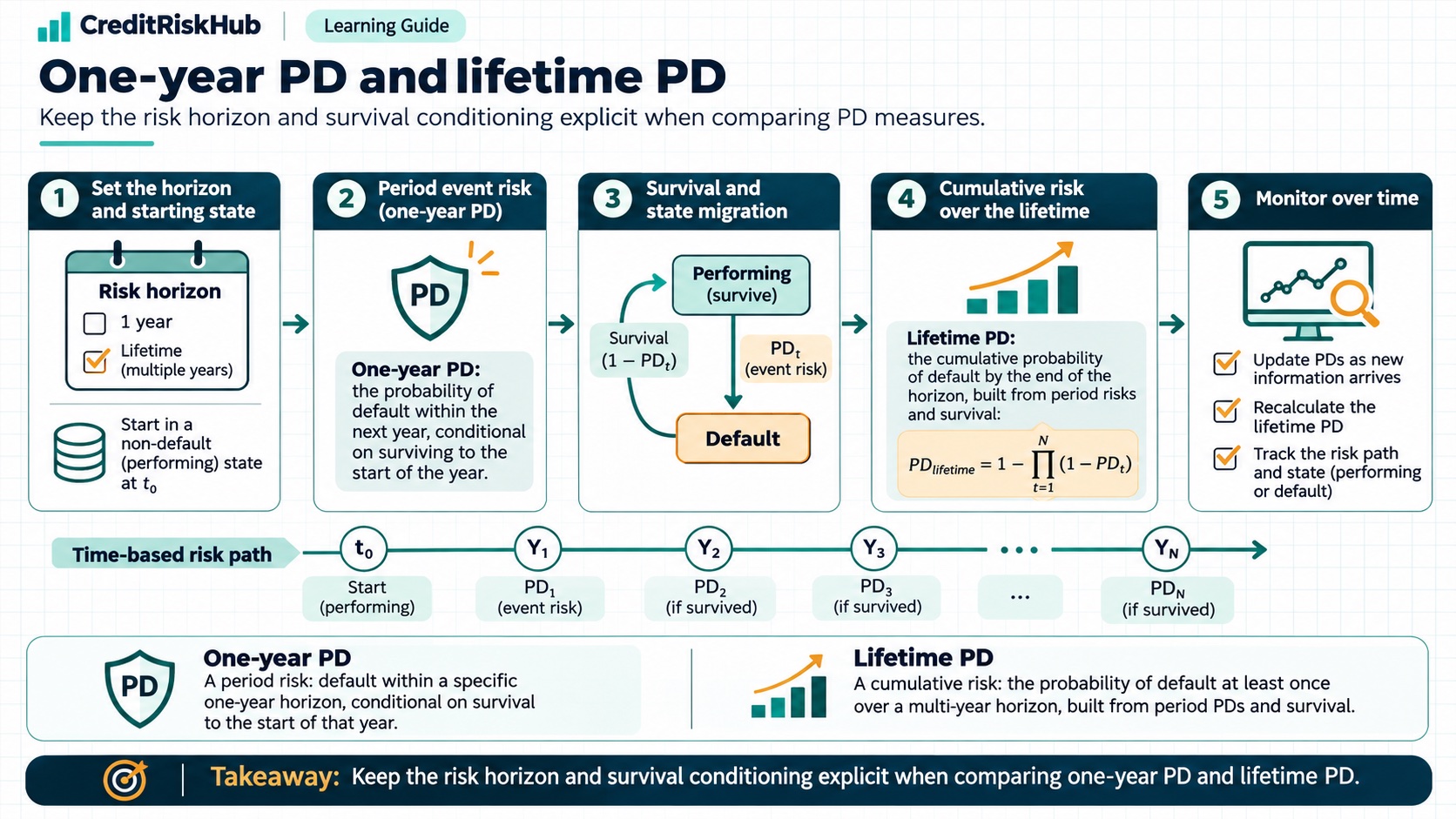
One-year PD and lifetime PD
Keep the risk horizon and survival conditioning explicit when comparing PD measures.
Purpose
Distinguish a one-year default probability from cumulative lifetime risk.
Key terms
Hover over or focus a term for a quick definition, or open its glossary entry.
Key definitions
- One-year PD measures default probability over a one-year horizon under a stated setup.
- Lifetime cumulative PD measures probability of default by a future time, conditional on being non-defaulted at the starting point.
Cumulative PD through T = 1 − Πₜ₌₁ᵀ(1 − conditional_PDₜ).Worked example: second- and third-year PD
Assume the conditional annual default probabilities are 2% in year 1, 3% in year 2 given survival to year 2, and 4% in year 3 given survival to year 3. These synthetic rates hold the setup fixed and ignore competing exits.
The year-2 conditional PD is 3%, but only 98% of the original cohort reaches year 2 without default. Therefore 2.94% of the original cohort defaults during year 2. By the end of year 2, cumulative PD is 4.94%.
Marginal PDₜ = Survival at start of year ₜ × Conditional PDₜ
Cumulative PD through T = Σₜ₌₁ᵀ Marginal PDₜ = 1 − Πₜ₌₁ᵀ(1 − Conditional PDₜ)| Year | Survival at start | Conditional PD | Marginal PD | Cumulative PD | Survival at end |
|---|---|---|---|---|---|
| 1 | 100.00% | 2.00% | 100.00% × 2.00% = 2.0000% | 2.0000% | 98.0000% |
| 2 | 98.0000% | 3.00% | 98.0000% × 3.00% = 2.9400% | 2.0000% + 2.9400% = 4.9400% | 95.0600% |
| 3 | 95.0600% | 4.00% | 95.0600% × 4.00% = 3.8024% | 4.9400% + 3.8024% = 8.7424% | 91.2576% |
Read the measures distinctly: conditional PD is the rate among accounts that survived to that year; marginal PD is that year’s default share of the original cohort; cumulative PD is the total default probability from the original starting point through that year. For example, year-3 cumulative PD is 8.7424%, not 2% + 3% + 4%.
Detailed explanation
A one-year probability and a lifetime probability answer different questions. The first limits the possible default event window; the second accumulates future risk as an account survives from period to period. If you have conditional marginal hazards, multiply survival probabilities across periods and subtract the resulting survival from one. The result is cumulative PD by the final period.
Do not add yearly conditional probabilities as if the same original population remained fully exposed to each year's risk. Specify whether a term structure is conditional on survival, unconditional marginal default probability, or cumulative PD. For accounting work, lifetime expected credit loss is not computed by applying a lifetime cumulative PD indiscriminately to every period; period-level cash shortfalls and risk parameters need consistent alignment.
Try a reproducible Python example
These examples use synthetic inputs and run locally in a browser worker. Edit the code, run it, and compare its output with the published example.
Runnable Python · local in your browser
Convert a logistic model logit to PD
Apply the logistic function to an illustrative intercept plus two feature contributions.
Output
Run the code to see the output.
Runtime loads only after you press Run. Code runs in a separate browser worker with a 10-second limit and a 20,000-character output cap. Use synthetic examples only; browser execution is not a secure environment for secrets or sensitive records.
Runnable Python · local in your browser
Calculate year-by-year marginal and cumulative PD
Follow years 1–3 separately: conditional PD is the rate among survivors, marginal PD is the share of the original cohort defaulting in that year, and cumulative PD adds those marginal shares.
Output
Run the code to see the output.
Runtime loads only after you press Run. Code runs in a separate browser worker with a 10-second limit and a 20,000-character output cap. Use synthetic examples only; browser execution is not a secure environment for secrets or sensitive records.
Assumptions
- The time origin, survival conditioning, and treatment of competing exits are disclosed.
Limitations
- Adding conditional PDs is generally incorrect because later risk applies to survivors.
- Lifetime horizons depend on contractual and behavioural expected-life assumptions.
References
- IFRS 9 Financial Instruments — IFRS Foundation
- Guidance on credit risk and accounting for expected credit losses — Basel Committee on Banking Supervision
Educational material only. Methods and examples are simplified; state and validate the assumptions required for your use case.