IFRS 9 expected credit loss
IFRS 9 stages and ECL horizons
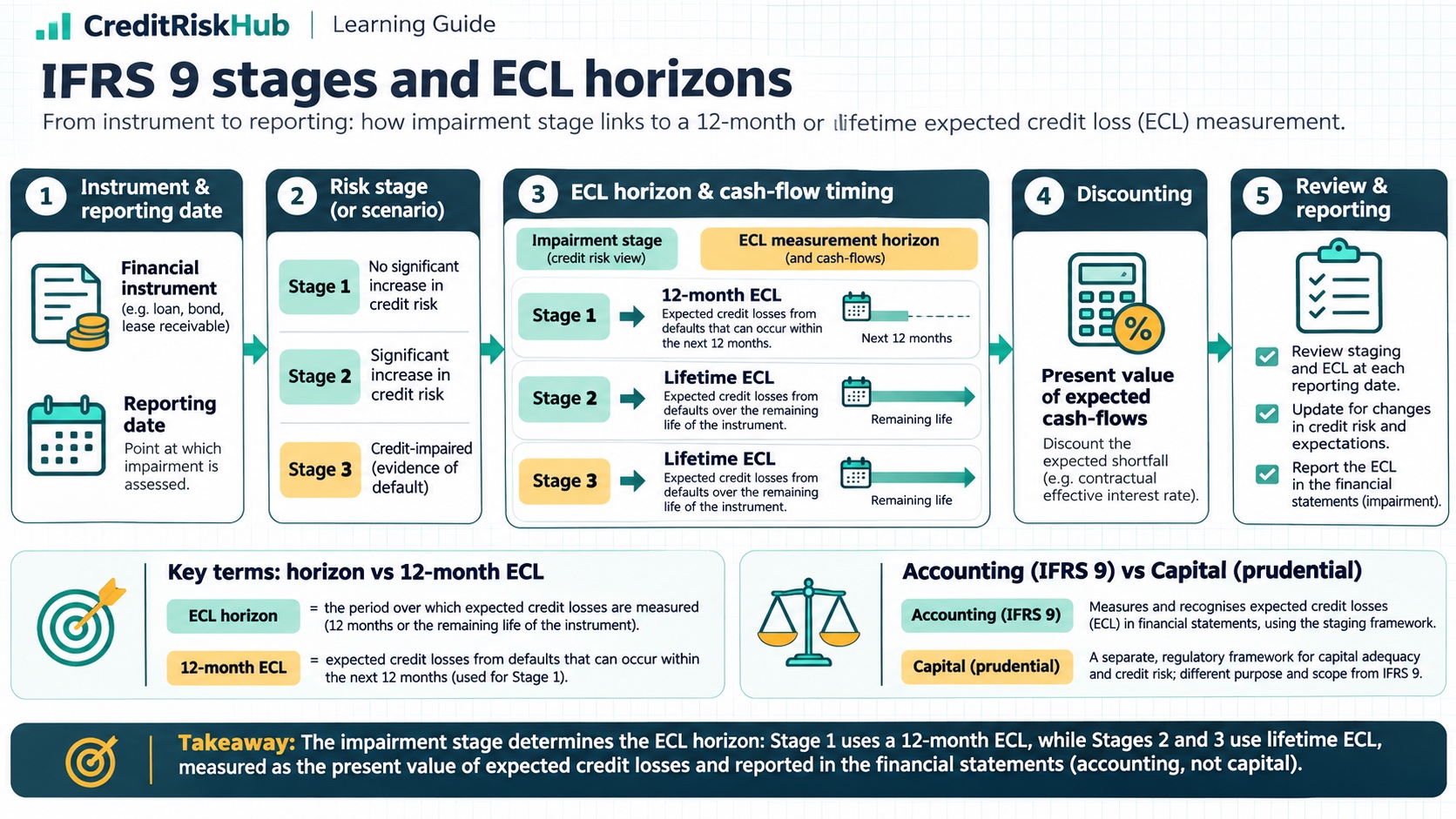
Connect impairment stage to 12-month or lifetime expected credit loss measurement.
Purpose
Explain the broad staging structure and distinguish loss horizon from the definition of 12-month ECL.
Key terms
Hover over or focus a term for a quick definition, or open its glossary entry.
Key definitions
- Stage 1 generally carries a 12-month ECL allowance; Stage 2 and Stage 3 generally use lifetime ECL, subject to the standard's requirements.
- 12-month ECL represents lifetime cash shortfalls associated with default events possible within the next 12 months.
Scenario ECL = Σₛ wₛ × Σₜ discounted expected cash shortfallₛ,ₜ, with event/horizon treatment matching the stage.Worked example
A Stage 1 loan may include the discounted lifetime shortfall if a default event occurs within the next 12 months; it is not simply every cash loss occurring within 12 months.
Detailed explanation
The general impairment model distinguishes credit risk that has not increased significantly since initial recognition from credit risk that has increased significantly and from credit-impaired assets. The stage determines whether the allowance is based on 12-month or lifetime expected credit losses, subject to detailed requirements, expedients, and special cases in IFRS 9.
The phrase 12-month ECL is easy to misread. It refers to losses associated with default events possible within the next 12 months, while the resulting cash shortfalls can occur over the remaining life of the instrument. Implementations must use applicable IFRS 9 wording, entity policies, and review controls rather than relying on this short teaching summary.
Try a reproducible Python example
These examples use synthetic inputs and run locally in a browser worker. Edit the code, run it, and compare its output with the published example.
Runnable Python · local in your browser
Calculate year-by-year marginal and cumulative PD
Follow years 1–3 separately: conditional PD is the rate among survivors, marginal PD is the share of the original cohort defaulting in that year, and cumulative PD adds those marginal shares.
Output
Run the code to see the output.
Runtime loads only after you press Run. Code runs in a separate browser worker with a 10-second limit and a 20,000-character output cap. Use synthetic examples only; browser execution is not a secure environment for secrets or sensitive records.
Runnable Python · local in your browser
Calculate survival-weighted, discounted ECL
Combine period marginal PD, LGD, EAD, discount factors, and two scenario weights in a small illustrative horizon.
Output
Run the code to see the output.
Runtime loads only after you press Run. Code runs in a separate browser worker with a 10-second limit and a 20,000-character output cap. Use synthetic examples only; browser execution is not a secure environment for secrets or sensitive records.
Assumptions
- Scope, low-credit-risk simplifications, purchased/originated credit-impaired rules, and instrument-specific exceptions are assessed under IFRS 9.
Limitations
- A simplified PD×LGD×EAD shortcut can miss important requirements.
- The summary is not a replacement for the licensed standard or entity accounting policy.
References
- IFRS 9 Financial Instruments — IFRS Foundation
- Guidance on credit risk and accounting for expected credit losses — Basel Committee on Banking Supervision
Educational material only. Methods and examples are simplified; state and validate the assumptions required for your use case.