IFRS 9 expected credit loss
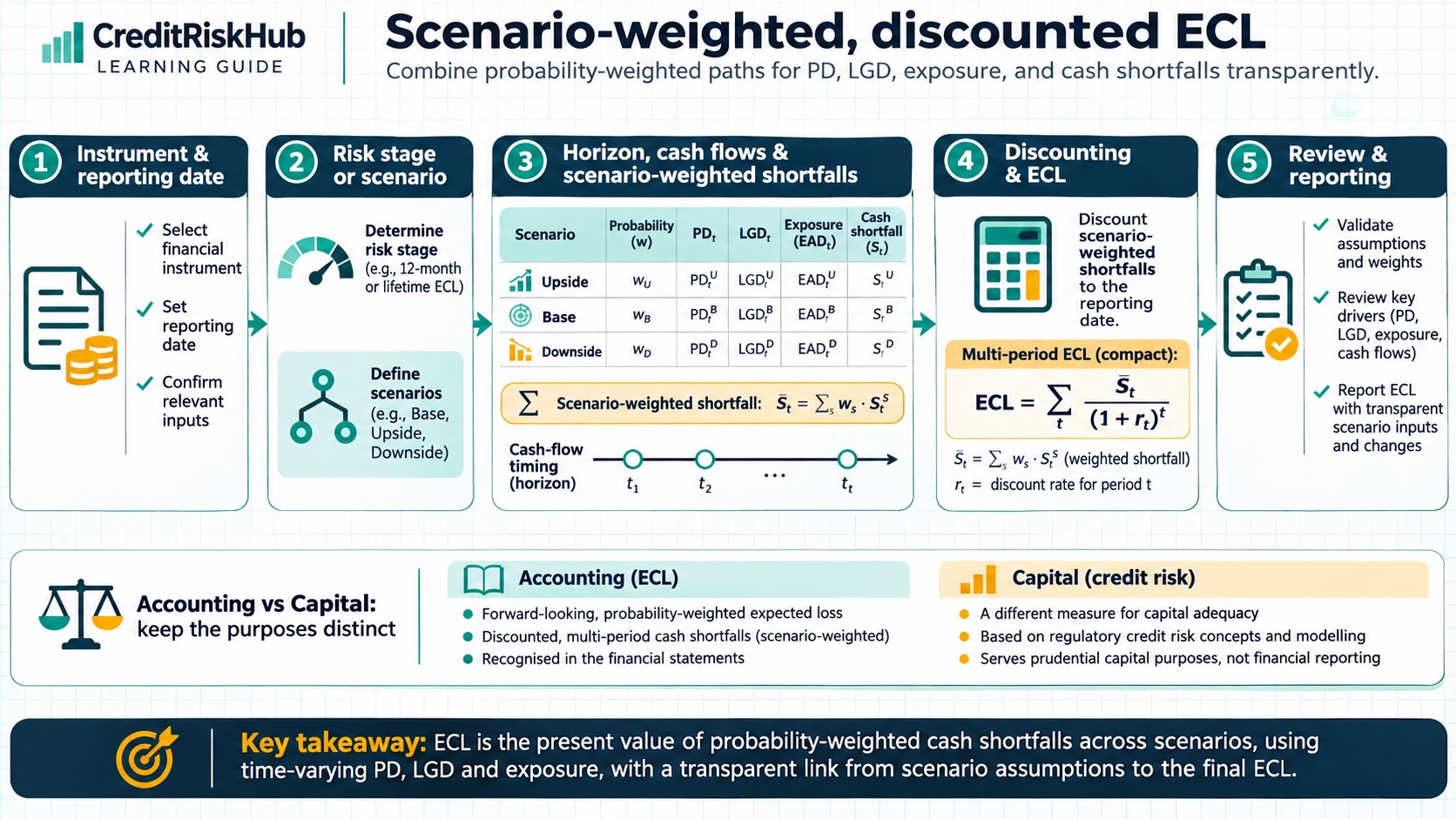
Scenario-weighted, discounted ECL
Combine probability-weighted paths for PD, LGD, exposure, and cash shortfalls transparently.
Purpose
Work through a compact multi-period ECL equation and show where scenario assumptions enter.
Key terms
Hover over or focus a term for a quick definition, or open its glossary entry.
Key definitions
- Expected credit loss is a probability-weighted estimate of credit losses over the required horizon.
- Discounting reflects the time value of money using the applicable effective interest rate basis.
ECL = Σₛ wₛ Σₜ PDₛ,ₜ(marginal) × LGDₛ,ₜ × EADₛ,ₜ × DFₜ.Worked example
Two scenarios with weights 60% and 40%, producing ECL $120 and $200, yield weighted ECL $152.
Detailed explanation
A transparent calculation separates the scenario weight from within-scenario period estimates. Use marginal default probability for each period among the relevant starting population; pair it with the period's loss severity and exposure. Apply an appropriate discount factor and sum periods, then weight scenario totals by their probabilities.
Validate that weights are non-negative and sum to one, all expected periods are present, and conditional versus marginal PD has not been mixed. This formula is an educational framework. The applicable accounting policy must determine contractual expected life, prepayment behavior, discounting, cash-shortfall treatment, and any specific IFRS 9 requirements.
Try a reproducible Python example
These examples use synthetic inputs and run locally in a browser worker. Edit the code, run it, and compare its output with the published example.
Runnable Python · local in your browser
Calculate year-by-year marginal and cumulative PD
Follow years 1–3 separately: conditional PD is the rate among survivors, marginal PD is the share of the original cohort defaulting in that year, and cumulative PD adds those marginal shares.
Output
Run the code to see the output.
Runtime loads only after you press Run. Code runs in a separate browser worker with a 10-second limit and a 20,000-character output cap. Use synthetic examples only; browser execution is not a secure environment for secrets or sensitive records.
Runnable Python · local in your browser
Calculate survival-weighted, discounted ECL
Combine period marginal PD, LGD, EAD, discount factors, and two scenario weights in a small illustrative horizon.
Output
Run the code to see the output.
Runtime loads only after you press Run. Code runs in a separate browser worker with a 10-second limit and a 20,000-character output cap. Use synthetic examples only; browser execution is not a secure environment for secrets or sensitive records.
Assumptions
- Scenario weights are supportable, sum to one, and each scenario uses internally consistent marginal risk and exposure paths.
Limitations
- The compact equation is only valid when PD, LGD, EAD, discounting, and horizon conventions align.
- Scenario probabilities and macro paths require governance and sensitivity analysis.
References
- IFRS 9 Financial Instruments — IFRS Foundation
- Guidance on credit risk and accounting for expected credit losses — Basel Committee on Banking Supervision
Educational material only. Methods and examples are simplified; state and validate the assumptions required for your use case.