IFRS 9 expected credit loss
Significant increase in credit risk
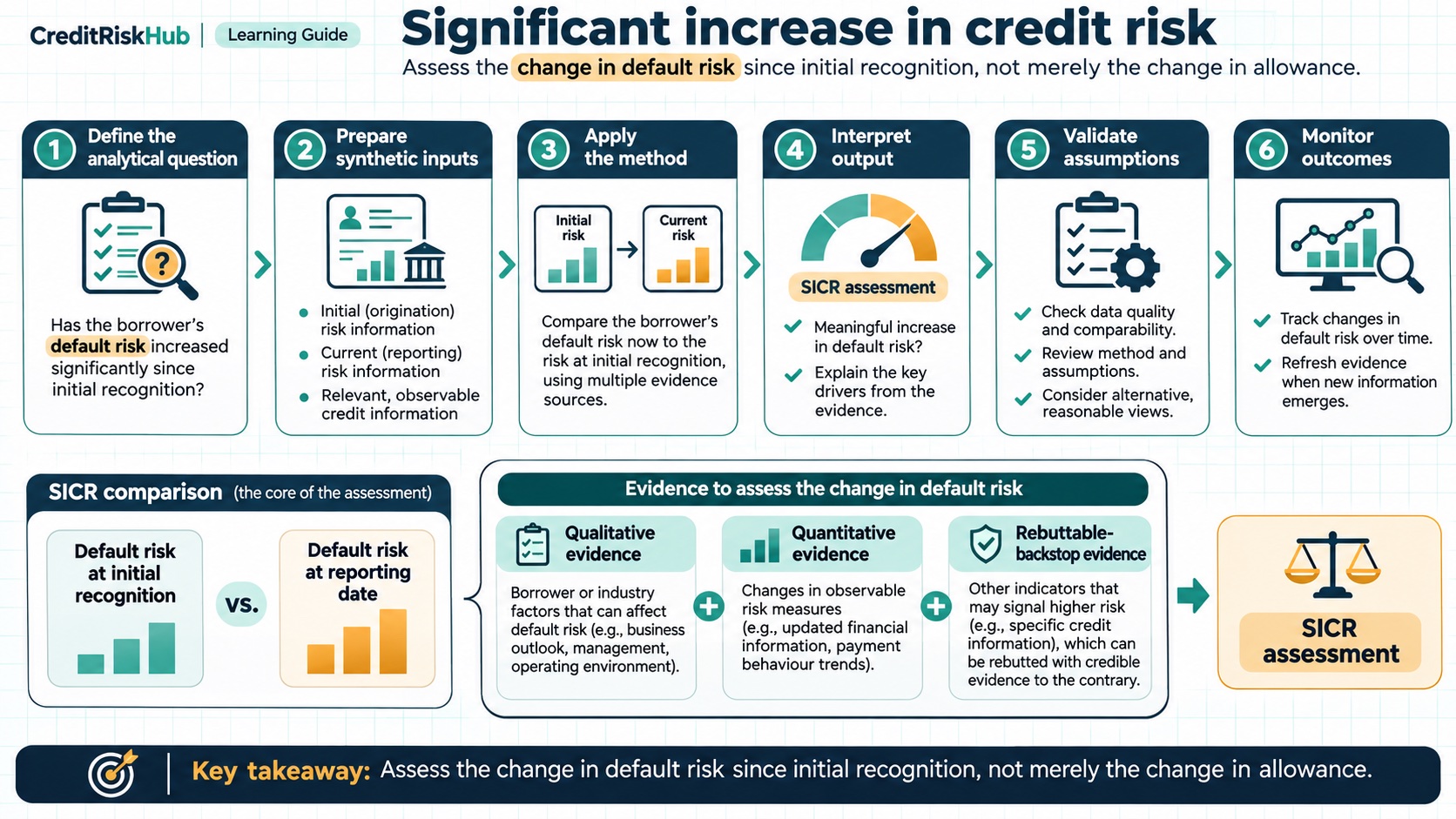
Assess the change in default risk since initial recognition, not merely the change in allowance.
Purpose
Describe the SICR comparison and the role of qualitative, quantitative, and rebuttable-backstop evidence.
Key terms
Hover over or focus a term for a quick definition, or open its glossary entry.
Key definitions
- SICR is an assessment of whether credit risk has increased significantly since initial recognition.
- The assessment concerns change in the risk of default over the expected life, under the standard's requirements.
Conceptual comparison: current lifetime default risk versus lifetime default risk at initial recognition, with instrument- and policy-specific methods.Worked example
A material deterioration in a borrower rating since origination may prompt further assessment even if the latest allowance amount changed little.
Detailed explanation
SICR is not the same as an increase in expected loss dollars. IFRS 9 describes assessing the change in the risk of a default occurring over the expected life since initial recognition. An institution may use quantitative tests, qualitative indicators, and a 30-days-past-due rebuttable presumption as specified by the standard and its policies.
Document initial recognition dates, comparable risk measures, watchlist and hardship signals, forward-looking inputs, exclusions, rebuttals, and overrides. Evaluate whether the method identifies deterioration early enough for the portfolio. Do not set a universal PD ratio or days-past-due threshold from an educational page; consult the current standard, applicable implementation guidance, and approved accounting policy.
Try a reproducible Python example
These examples use synthetic inputs and run locally in a browser worker. Edit the code, run it, and compare its output with the published example.
Runnable Python · local in your browser
Calculate year-by-year marginal and cumulative PD
Follow years 1–3 separately: conditional PD is the rate among survivors, marginal PD is the share of the original cohort defaulting in that year, and cumulative PD adds those marginal shares.
Output
Run the code to see the output.
Runtime loads only after you press Run. Code runs in a separate browser worker with a 10-second limit and a 20,000-character output cap. Use synthetic examples only; browser execution is not a secure environment for secrets or sensitive records.
Runnable Python · local in your browser
Calculate survival-weighted, discounted ECL
Combine period marginal PD, LGD, EAD, discount factors, and two scenario weights in a small illustrative horizon.
Output
Run the code to see the output.
Runtime loads only after you press Run. Code runs in a separate browser worker with a 10-second limit and a 20,000-character output cap. Use synthetic examples only; browser execution is not a secure environment for secrets or sensitive records.
Assumptions
- Initial-recognition and reporting-date information are comparable and include reasonable, supportable forward-looking information.
Limitations
- No single numeric threshold applies to every portfolio or entity.
- Operational data gaps can make initial-risk comparisons unreliable.
References
- IFRS 9 Financial Instruments — IFRS Foundation
- Guidance on credit risk and accounting for expected credit losses — Basel Committee on Banking Supervision
Educational material only. Methods and examples are simplified; state and validate the assumptions required for your use case.