Exposure at default (EAD)
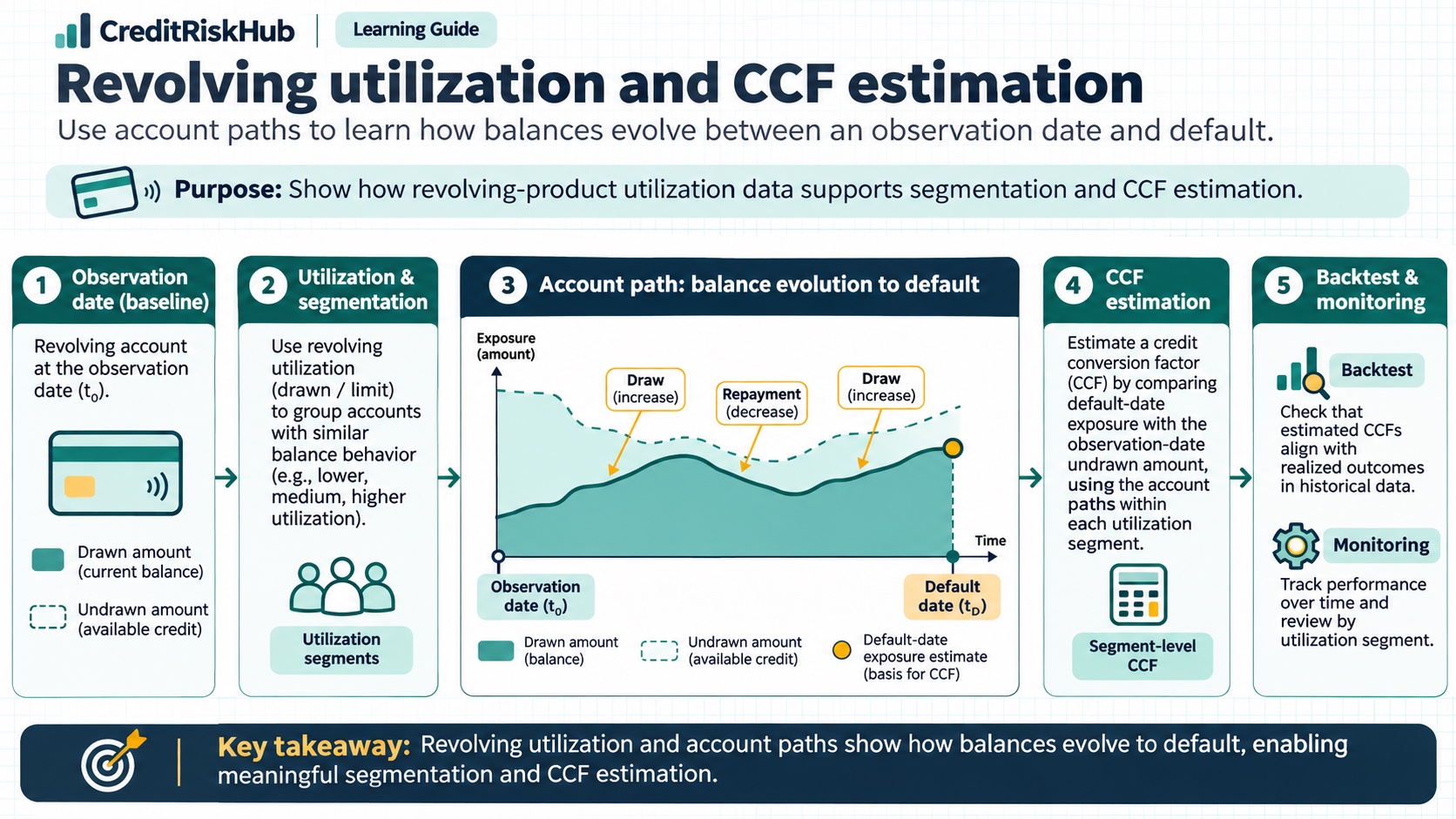
Revolving utilization and CCF estimation
Use account paths to learn how balances evolve between an observation date and default.
Purpose
Show how revolving-product utilization data supports segmentation and CCF estimation.
Key terms
Hover over or focus a term for a quick definition, or open its glossary entry.
Key definitions
- Utilization is drawn balance divided by an available credit limit under a stated convention.
- CCF measures the change in drawn exposure relative to undrawn availability before default.
Utilization = drawn/limit; CCF = (EAD at default − drawn at reference date)/undrawn at reference date.Worked example
A $2,000 balance on a $5,000 limit has 40% utilization; if EAD at default is $3,200, the CCF on $3,000 undrawn is 40%.
Detailed explanation
Revolving products can experience rapid utilization changes. Use a clear reference date before default, align the commitment limit to that date, and define how accounts with limit reductions, frozen cards, repayments, or over-limit balances are handled. Segment by product mechanics where behavior differs.
Estimate conversion using a representative default sample and compare against non-default account paths to understand selection. Inspect distributions rather than relying only on averages: the tail of drawdown can be important for exposure. Backtest forecasts by time and product and distinguish observed utilization from a forward-looking expected exposure path used for impairment.
Try a reproducible Python example
These examples use synthetic inputs and run locally in a browser worker. Edit the code, run it, and compare its output with the published example.
Runnable Python · local in your browser
Estimate revolving EAD with a CCF
Apply a hypothetical conversion factor to the currently undrawn facility limit.
Output
Run the code to see the output.
Runtime loads only after you press Run. Code runs in a separate browser worker with a 10-second limit and a 20,000-character output cap. Use synthetic examples only; browser execution is not a secure environment for secrets or sensitive records.
Runnable Python · local in your browser
Summarize rating migration, arrears roll, and recovery LGD
Use synthetic account paths to calculate grade transitions, a delinquency roll rate, and a simple discounted recovery outcome.
Output
Run the code to see the output.
Runtime loads only after you press Run. Code runs in a separate browser worker with a 10-second limit and a 20,000-character output cap. Use synthetic examples only; browser execution is not a secure environment for secrets or sensitive records.
Assumptions
- Limits and balances are observed consistently, with treatment for limit changes and repayments documented.
Limitations
- A zero or changing limit makes the basic ratio undefined or misleading.
- Defaulted accounts may be a selected sample of utilization behavior.
References
- Guidelines on PD estimation, LGD estimation and treatment of defaulted assets — European Banking Authority
- Basel Framework: IRB approach and credit-risk components — Basel Committee on Banking Supervision
Educational material only. Methods and examples are simplified; state and validate the assumptions required for your use case.