Exposure at default (EAD)
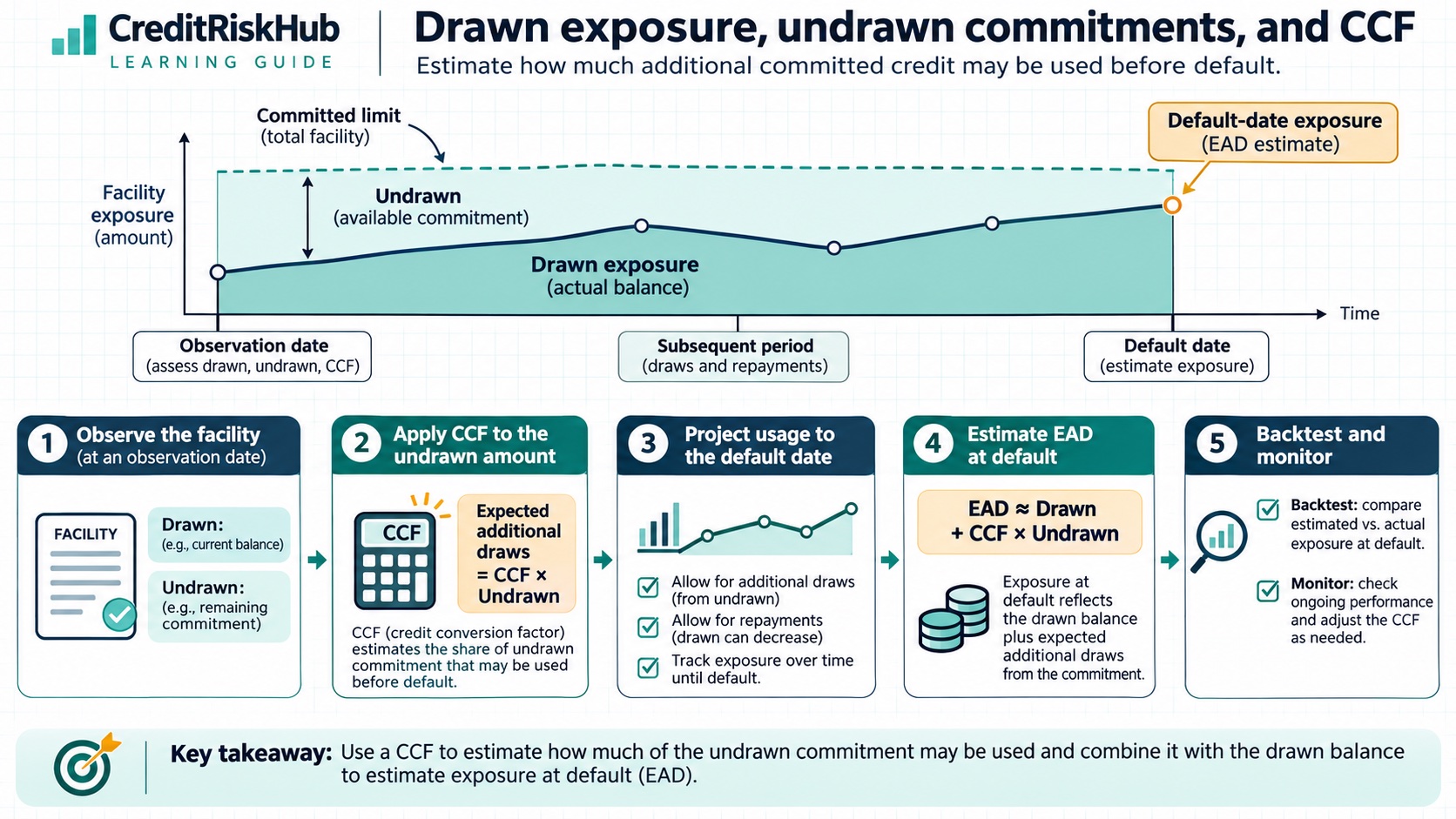
Drawn exposure, undrawn commitments, and CCF
Estimate how much additional committed credit may be used before default.
Purpose
Introduce a CCF-based EAD estimate for a facility with drawn and undrawn balances.
Key terms
Hover over or focus a term for a quick definition, or open its glossary entry.
Key definitions
- EAD is an estimate of exposure at the point of default.
- A credit conversion factor (CCF) estimates the portion of undrawn commitment expected to be drawn by default.
Illustrative EAD = drawn balance + CCF × max(commitment − drawn balance, 0).Worked example
Drawn $6,000, commitment $10,000, and CCF 40% produce EAD $7,600.
Detailed explanation
For a simple facility, EAD combines what is already drawn with an estimate of future drawing from the available commitment. The undrawn amount is not automatically treated as fully exposed, nor is it automatically zero. A CCF captures historical or modeled utilization change between an observation date and default, under a defined product and window.
Validate facility limits, frozen or cancelled commitments, over-limit balances, repayments, and changes in commitment. State whether the estimate is conditional on default and whether conversion factors are pooled or modeled by product, risk, or utilization. A Basel regulatory CCF is not necessarily the same parameter used in an IFRS 9 cash-shortfall projection.
Try a reproducible Python example
These examples use synthetic inputs and run locally in a browser worker. Edit the code, run it, and compare its output with the published example.
Runnable Python · local in your browser
Estimate revolving EAD with a CCF
Apply a hypothetical conversion factor to the currently undrawn facility limit.
Output
Run the code to see the output.
Runtime loads only after you press Run. Code runs in a separate browser worker with a 10-second limit and a 20,000-character output cap. Use synthetic examples only; browser execution is not a secure environment for secrets or sensitive records.
Runnable Python · local in your browser
Summarize rating migration, arrears roll, and recovery LGD
Use synthetic account paths to calculate grade transitions, a delinquency roll rate, and a simple discounted recovery outcome.
Output
Run the code to see the output.
Runtime loads only after you press Run. Code runs in a separate browser worker with a 10-second limit and a 20,000-character output cap. Use synthetic examples only; browser execution is not a secure environment for secrets or sensitive records.
Assumptions
- The reference date, default date, commitment amount, and drawn balance are aligned.
Limitations
- CCF can be negative or exceed one in observed data depending on definitions and product behavior.
- Prudential and accounting exposure methods may differ.
References
- Basel Framework: IRB approach and credit-risk components — Basel Committee on Banking Supervision
- IFRS 9 Financial Instruments — IFRS Foundation
Educational material only. Methods and examples are simplified; state and validate the assumptions required for your use case.