Exposure at default (EAD)
Product-level EAD forecasting
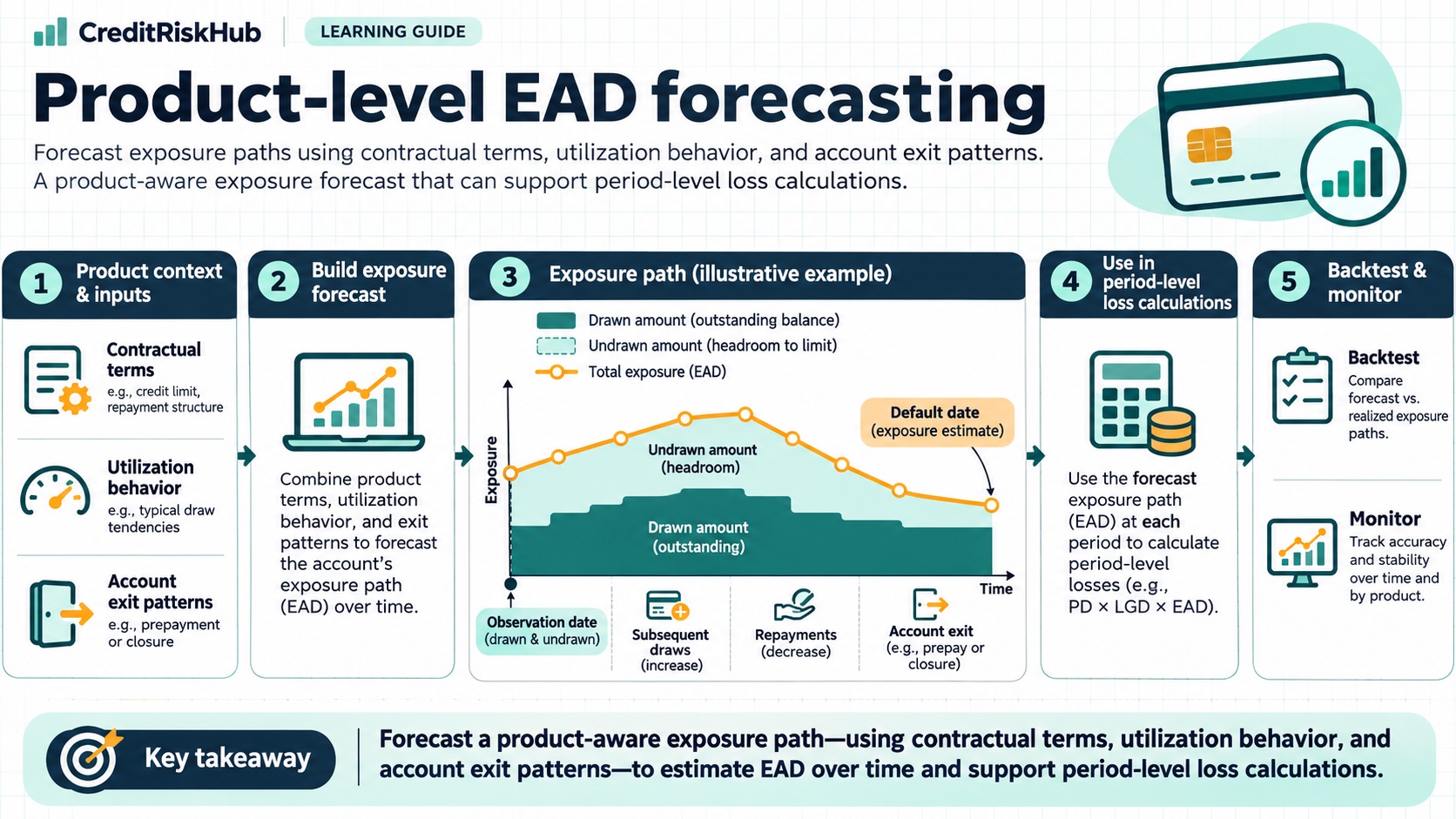
Forecast exposure paths using contractual terms, utilization behavior, and account exit patterns.
Purpose
Outline a product-aware exposure forecast that can support period-level loss calculations.
Key terms
Hover over or focus a term for a quick definition, or open its glossary entry.
Key definitions
- An EAD path is projected exposure at future periods or default dates.
- Amortization and prepayment change the balance trajectory; redraw rights can increase it.
Projected balanceₜ = prior balance + drawsₜ − repaymentsₜ − prepaymentsₜ, subject to contractual constraints.Worked example
A term loan forecast reduces principal by scheduled repayments; a revolving line may retain or increase available utilization before default.
Detailed explanation
Different products require different exposure forecasts. An amortizing installment loan follows a contractual payment schedule, adjusted for observed prepayment behavior when appropriate. A revolving facility can have future drawings. A mortgage, credit card, lease, and trade line each has distinct exposure, payment, and closure mechanics.
Represent exposure by period when the loss model requires it. Keep contractual schedules separate from behavioral overlays, and test forecasts against realized balances at default or at equivalent observation points. Treat limit changes, refinancing, restructuring, charge-offs, and account closure consistently. Explain the horizon and whether the forecast is for accounting ECL, prudential capital, pricing, or another use.
Try a reproducible Python example
These examples use synthetic inputs and run locally in a browser worker. Edit the code, run it, and compare its output with the published example.
Runnable Python · local in your browser
Estimate revolving EAD with a CCF
Apply a hypothetical conversion factor to the currently undrawn facility limit.
Output
Run the code to see the output.
Runtime loads only after you press Run. Code runs in a separate browser worker with a 10-second limit and a 20,000-character output cap. Use synthetic examples only; browser execution is not a secure environment for secrets or sensitive records.
Runnable Python · local in your browser
Summarize rating migration, arrears roll, and recovery LGD
Use synthetic account paths to calculate grade transitions, a delinquency roll rate, and a simple discounted recovery outcome.
Output
Run the code to see the output.
Runtime loads only after you press Run. Code runs in a separate browser worker with a 10-second limit and a 20,000-character output cap. Use synthetic examples only; browser execution is not a secure environment for secrets or sensitive records.
Assumptions
- Contractual schedules, payment behavior, limits, and closure/prepayment data are time-aligned.
Limitations
- Behavioral assumptions can fail when products, policies, or economic conditions change.
- A single static EAD may not represent lifetime exposure.
References
- IFRS 9 Financial Instruments — IFRS Foundation
- Guidance on credit risk and accounting for expected credit losses — Basel Committee on Banking Supervision
Educational material only. Methods and examples are simplified; state and validate the assumptions required for your use case.