Exposure at default (EAD)
IFRS 9 EAD versus regulatory EAD
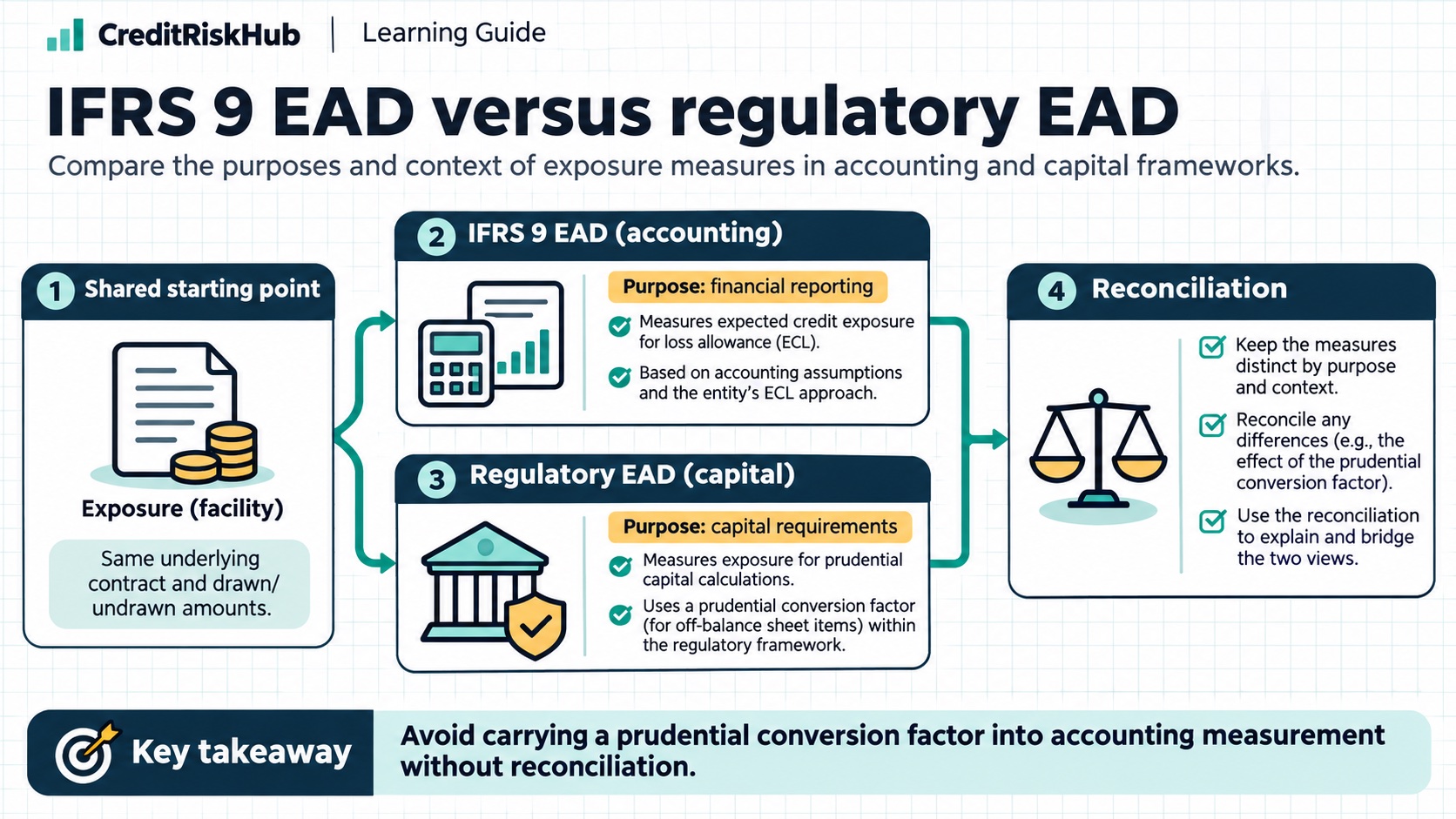
Avoid carrying a prudential conversion factor into accounting measurement without reconciliation.
Purpose
Compare the purposes and context of exposure measures used in accounting and capital frameworks.
Key terms
Hover over or focus a term for a quick definition, or open its glossary entry.
Key definitions
- IFRS 9 measures expected credit losses using cash-shortfall concepts and forward-looking information.
- Basel IRB risk components support regulatory capital calculations and have prudential minimum requirements.
Accounting ECL may be scenario-weighted by period; regulatory expected loss and capital formulas use framework-specific PD, LGD, and EAD inputs.Worked example
One revolving account can have different EAD estimates for lifetime accounting cash flows and a prudential capital exposure under prescribed rules.
Detailed explanation
The acronym EAD appears in multiple frameworks, but a shared label does not guarantee shared measurement. Regulatory IRB estimates are part of a capital framework with defined default, data, and parameter requirements. IFRS 9 ECL is an accounting measurement that considers expected cash shortfalls, time value, and reasonable and supportable forward-looking information.
Where institutions reuse systems, data, or model components, document the purpose-specific changes: horizon, scenarios, contractual expected life, CCF treatment, discounting, and default definitions. Reconcile differences rather than forcing equality. Consult the applicable standard and supervisory rules for the institution and jurisdiction; this educational comparison is not an implementation checklist.
Try a reproducible Python example
These examples use synthetic inputs and run locally in a browser worker. Edit the code, run it, and compare its output with the published example.
Runnable Python · local in your browser
Estimate revolving EAD with a CCF
Apply a hypothetical conversion factor to the currently undrawn facility limit.
Output
Run the code to see the output.
Runtime loads only after you press Run. Code runs in a separate browser worker with a 10-second limit and a 20,000-character output cap. Use synthetic examples only; browser execution is not a secure environment for secrets or sensitive records.
Runnable Python · local in your browser
Summarize rating migration, arrears roll, and recovery LGD
Use synthetic account paths to calculate grade transitions, a delinquency roll rate, and a simple discounted recovery outcome.
Output
Run the code to see the output.
Runtime loads only after you press Run. Code runs in a separate browser worker with a 10-second limit and a 20,000-character output cap. Use synthetic examples only; browser execution is not a secure environment for secrets or sensitive records.
Assumptions
- The reporting framework, portfolio, horizon, and contractual treatment are identified before comparing measures.
Limitations
- There is no universal conversion from regulatory EAD to IFRS 9 exposure paths.
- Institution-specific bridges require governance and documentation.
References
- IFRS 9 Financial Instruments — IFRS Foundation
- Guidance on credit risk and accounting for expected credit losses — Basel Committee on Banking Supervision
- Basel Framework: IRB approach and credit-risk components — Basel Committee on Banking Supervision
Educational material only. Methods and examples are simplified; state and validate the assumptions required for your use case.