Loss given default (LGD)
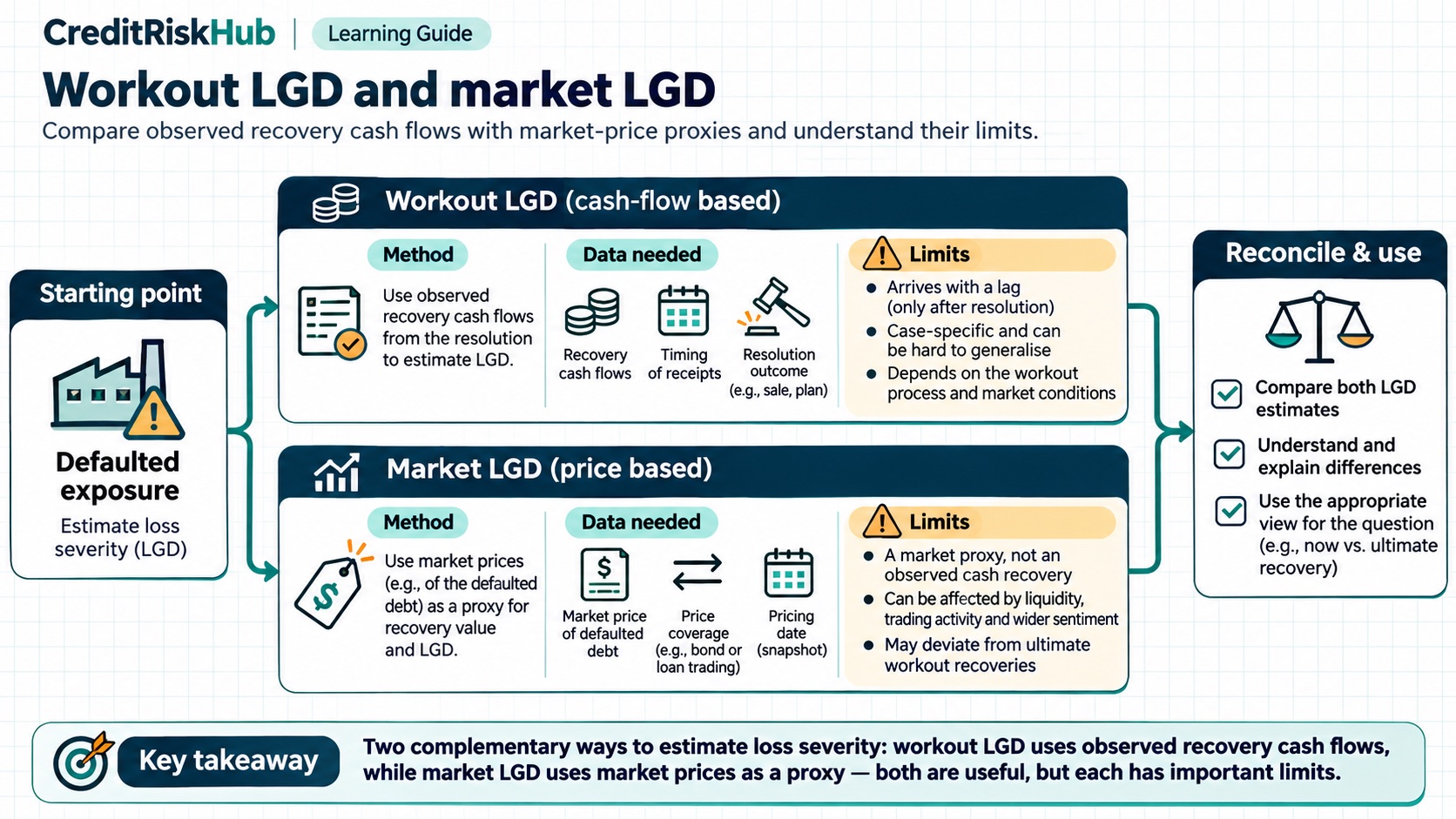
Workout LGD and market LGD
Compare observed recovery cash flows with market-price proxies and understand their limits.
Purpose
Describe two broad ways to estimate loss severity and the data each one needs.
Key terms
Hover over or focus a term for a quick definition, or open its glossary entry.
Key definitions
- Workout LGD is estimated from post-default recoveries and costs over time.
- Market LGD uses market prices or traded distressed-obligation values as a proxy for economic loss.
Workout estimate: 1 − PV(net recoveries)/EAD; market proxy: 1 − observed distressed value/reference exposure, after method-specific adjustments.Worked example
A $100 claim sold for $42 implies a raw market discount of 58%, before transaction and representativeness adjustments.
Detailed explanation
Workout data can directly reflect realized cash recovery and cost timing, but they take time to mature and can be incomplete. Market-based observations may be available faster and can reflect current conditions, but may include liquidity discounts or instruments that differ from the portfolio being modeled.
Treat the methods as data choices with distinct assumptions rather than interchangeable labels. Segment by product, seniority, collateral, jurisdiction, and recovery route where possible. Compare both against subsequent outcomes and document adjustments. If either approach is used for IFRS 9 measurement or regulatory capital, follow the applicable framework rather than importing a textbook shortcut.
Try a reproducible Python example
These examples use synthetic inputs and run locally in a browser worker. Edit the code, run it, and compare its output with the published example.
Runnable Python · local in your browser
Link re-default episodes and calculate discounted LGD
Apply a declared synthetic 12-month cure probation and compute two episode LGDs from bounded cashflow lists.
Output
Run the code to see the output.
Runtime loads only after you press Run. Code runs in a separate browser worker with a 10-second limit and a 20,000-character output cap. Use synthetic examples only; browser execution is not a secure environment for secrets or sensitive records.
Runnable Python · local in your browser
Discount recovery cash flows for workout LGD
Discount synthetic recoveries and costs to default date and calculate a capped loss fraction.
Output
Run the code to see the output.
Runtime loads only after you press Run. Code runs in a separate browser worker with a 10-second limit and a 20,000-character output cap. Use synthetic examples only; browser execution is not a secure environment for secrets or sensitive records.
Assumptions
- The selected method represents the product, collateral, seniority, and observation horizon of interest.
Limitations
- Market prices may include liquidity, risk premia, and market stress unrelated to a long-run workout path.
- Workout samples may be incomplete or slow to mature.
References
- Guidelines on PD estimation, LGD estimation and treatment of defaulted assets — European Banking Authority
- Basel Framework: IRB approach and credit-risk components — Basel Committee on Banking Supervision
- Guidance on credit risk and accounting for expected credit losses — Basel Committee on Banking Supervision
Educational material only. Methods and examples are simplified; state and validate the assumptions required for your use case.