Loss given default (LGD)
LGD Recovery Cash Flows, Workout Costs, and Discounting
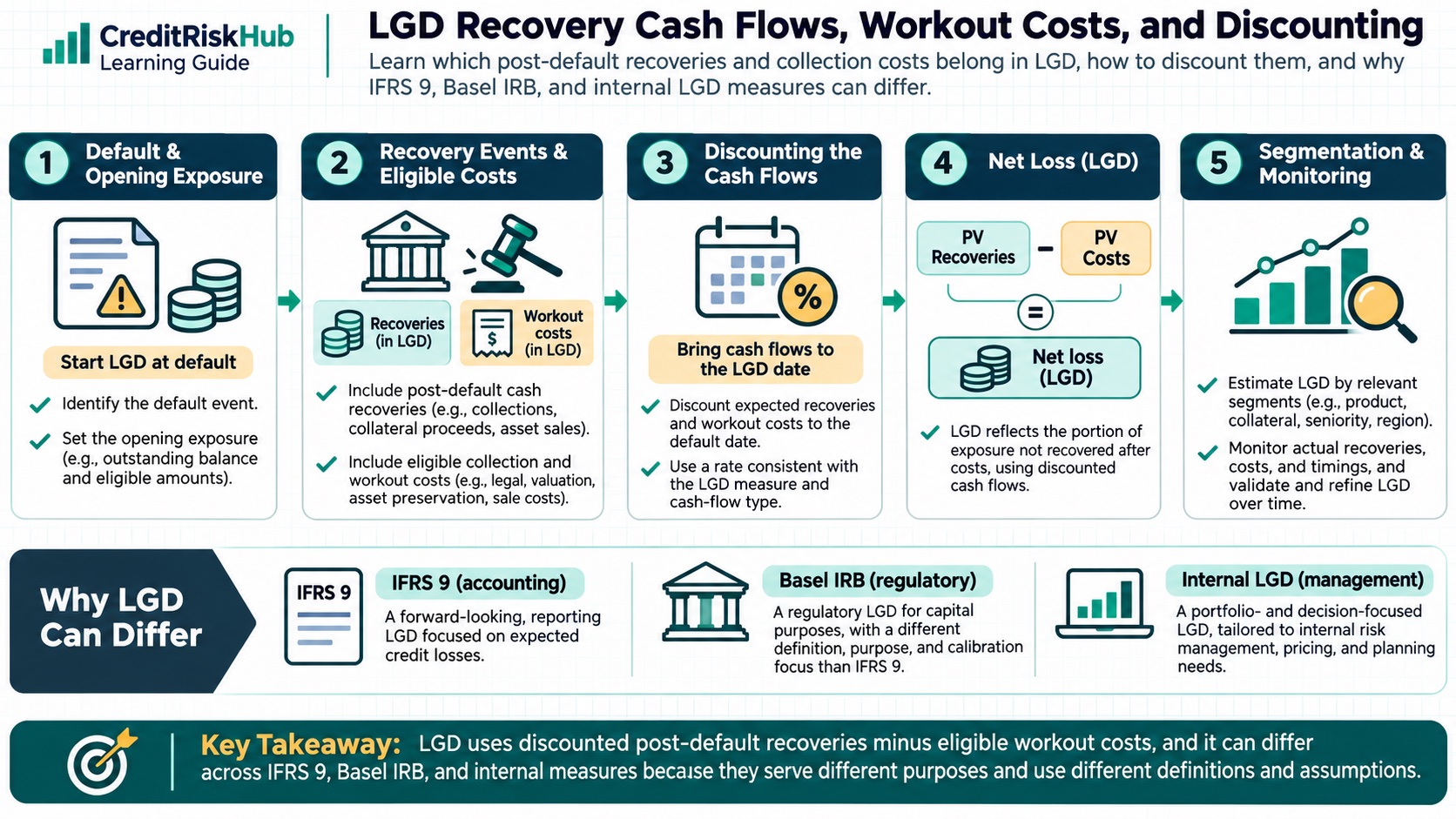
Learn which post-default recoveries and collection costs belong in LGD, how to discount them, and why IFRS 9, Basel IRB, and internal LGD measures can differ.
Updated 2026-10-26
Purpose
Learn which post-default recoveries and collection costs belong in LGD, how to discount them, and why IFRS 9, Basel IRB, and internal LGD measures can differ.
Key terms
Hover over or focus a term for a quick definition, or open its glossary entry.
\[ \text{PV}(CF_i) = \frac{CF_i}{(1+r)^{(t_i-t_0)}}. \]
\[ \text{PV(net recoveries)} = \sum_i \frac{\text{recovery}_i - \text{cost}_i}{(1+r)^{\Delta t_i}}. \]
At 0.5 years: \((20,000-4,000)/(1.08)^{0.5} = \$15,396.01\). At 1 year: \((5,000-2,000)/1.08 = \$2,777.78\). At 2 years: \((55,000-3,000)/(1.08)^2 = \$44,581.62\).
PURPOSE
Loss given default (LGD) is sensitive to more than collateral value. It depends on which cash inflows count as recoveries, which expenses are attributable to collecting the exposure, when those cash flows occur, and the framework's discounting rules. This guide sets out a practical cash-flow inventory, a worked synthetic example, and the differences between accounting expected credit losses (ECL), Basel IRB LGD, and internal or pricing LGD.
START WITH THE MEASUREMENT PURPOSE
Before building the calculation, specify the unit of analysis (obligor or facility), default definition, exposure at default (EAD), workout start and end rules, currency, and purpose. Keep these consistent in the numerator and denominator. A workout-LGD estimate used for historical analysis is not automatically the right parameter for an IFRS 9 allowance or a regulatory capital calculation.
For a common realized-workout convention:
\[ \text{LGD} = \frac{\text{EAD at default} - \text{PV of net recoveries}}{\text{EAD at default}} = 1 - \frac{\text{PV of net recoveries}}{\text{EAD at default}}. \]
This is a useful framework for analysis, not a universal rule that overrides the applicable accounting standard, regulatory requirements, or approved model policy. Basel IRB defines loss economically and requires material discount effects and material direct and indirect collection costs to be included. Basel Framework CRE36.76 (https://www.bis.org/basel_framework/chapter/CRE/36.htm?inforce=20191215&published=20191215&tldate=20050625)
RECOVERY CASH FLOWS TO CONSIDER
Build a dated ledger of cash received because the exposure is being resolved. Depending on the exposure and the framework, this can include:
Borrower payments received after default, including settlement or restructuring payments attributable to the exposure. Cash proceeds from collateral after repossession or foreclosure, with priority claims and sale expenses handled consistently. Payments from a guarantor, insurer, or another credit enhancement when it qualifies for the measure being calculated. Cash proceeds from selling or assigning the defaulted receivable. Other realized proceeds directly linked to collecting the exposure.
For each item, preserve amount, date, currency, source, facility allocation, and whether it is gross or already net of costs. For collateral, use expected or realized liquidation proceeds and their timing; a market appraisal is not cash recovery. Consider lien priority, enforceability, time to take possession, market depth, borrower/collateral dependence, and currency mismatch. Basel explicitly cautions against basing LGD solely on collateral's estimated market value. Basel Framework CRE36.85–36.87 (https://www.bis.org/basel_framework/chapter/CRE/36.htm?inforce=20191215&published=20191215&tldate=20050625)
WORKOUT COSTS TO CONSIDER
Include material expenses with a clear link to collection, enforcement, preservation, or realization, such as:
Legal, court, trustee, enforcement, and external counsel fees. Repossession, foreclosure, collateral valuation, auction, broker, and sale fees. Collection-agency charges and other external workout services. Necessary security, insurance, storage, maintenance, and property taxes during recovery. A supportable allocation of material indirect workout costs, such as recovery-team effort, when the allocation is consistent and tied to collection activity.
The cost must relate to the workout, and the allocation must be documented. Broad corporate overhead is not automatically a collection cost. Neither are origination, underwriting, or ordinary servicing expenses merely because they relate to the loan.
Avoid double counting. If collateral-sale proceeds are reported net of broker and legal charges, do not subtract those same charges a second time. Keep provisions, write-offs, and accounting loss entries separate from cash recoveries and workout expenses; they are not substitutes for the economic cash-flow history.
Post-default interest, capitalized fees, and additional drawings need explicit policy. Their treatment can depend on the regulatory or accounting framework and on whether they are actual cash flows, included in EAD, or incurred cash outflows. Do not add an item to only one side of the LGD ratio. The EBA's PD/LGD guidance discusses realized-LGD cash flows, costs, fees, and denominator consistency. EBA Guidelines on PD and LGD estimation (https://www.eba.europa.eu/documents/10180/2033363/6b062012-45d6-4655-af04-801d26493ed0/Guidelines%20on%20PD%20and%20LGD%20estimation%20%28EBA-GL-2017-16%29.pdf)
DISCOUNTING CASH FLOWS
For a cash flow at time \(t_i\), discounted to date \(t_0\) at an effective annual rate \(r\):
Use signed cash flows: receipts are positive and costs are negative. Then:
Match the discount-rate convention, day-count, compounding, currency, and date basis to the method. Discount all relevant recovery and cost cash flows consistently. If you change the reference date, discount cash flows to that date before using them in the loss calculation.
WORKED SYNTHETIC EXAMPLE
Assume EAD at default is $100,000. For illustration only, use an 8% effective annual rate and annual compounding, discounting workout cash flows to the default date.
Cash flow — Timing after default — Amount Borrower settlement — 0.5 years — +$20,000 Guarantor payment — 1 year — +$5,000 Collateral sale proceeds — 2 years — +$55,000 Legal costs — 0.5 years — −$4,000 Collateral maintenance — 1 year — −$2,000 Sale costs — 2 years — −$3,000
Net each same-date flow, then discount:
The PV of net recoveries is about $62,755.41 (rounding individual rows can cause a one-cent difference). The illustrative workout LGD is:
\[ \frac{100,000 - 62,755.40}{100,000} = 37.24\%. \]
The 8% rate is a teaching assumption; it is not a prescribed IFRS 9 or Basel discount rate. If a recovery has already been stated at present value or net of costs, adjust the ledger so it is not discounted or netted twice.
IFRS 9 ECL: DISCOUNT TO THE REPORTING DATE
IFRS 9 measures ECL as a probability-weighted present value of cash shortfalls. For a collateralized financial instrument, the estimate reflects the amount and timing of expected foreclosure cash flows less the costs of obtaining and selling collateral. Qualifying credit-enhancement cash flows are included only when the relevant contractual-integral and separate-recognition conditions are met; a benefit recognized separately must not be counted again in the asset's ECL. IFRS Foundation staff paper summarizing IFRS 9 collateral guidance (https://www.ifrs.org/-/media/feature/meetings/2015/december/itg/impairment-of-financial-instruments/ap5-collateral-and-other-credit-enhancements.pdf)
Expected credit losses are discounted to the reporting date, not simply to the expected default date. The general rate is the original effective interest rate (or an approximation); floating-rate instruments use the current effective interest rate under the standard's requirements. Purchased or originated credit-impaired assets use the credit-adjusted effective interest rate, with other instrument types having specific rules. IFRS Foundation staff paper on the IFRS 9 effective interest rate (https://www.ifrs.org/-/media/feature/meetings/2015/december/itg/impairment-of-financial-instruments/ap7-meaning-of-current-effective-interest-rate.pdf)
IFRS 9 does not prescribe one standalone “LGD percentage” formula for every modeling architecture. Institutions may use PD, LGD, and EAD components as an estimation technique, but the resulting ECL must meet IFRS 9's cash-shortfall, probability-weighting, forward-looking, and discounting requirements. Do not discount recoveries once to default date and then accidentally omit the additional timing from default to reporting date—or discount the same interval twice.
BASEL IRB: ECONOMIC AND, WHERE NEEDED, DOWNTURN LOSS
Basel IRB LGD is a prudential parameter. It uses economic loss, including material discount effects and material direct and indirect collection costs. For relevant exposures, the estimate must reflect downturn conditions where necessary and cannot be less than the long-run default-weighted average loss rate given default. Collateral eligibility, enforcement, borrower/collateral dependence, and currency mismatch also matter. Basel Framework CRE36.76 and CRE36.85–36.90 (https://www.bis.org/basel_framework/chapter/CRE/36.htm?inforce=20191215&published=20191215&tldate=20050625)
There is not one universal discount rate that can be copied into every IRB or internal model. Basel Committee supervisory guidance describes discounting recovery and workout-cost cash flows using a risk-adjusted rate, or using equivalent certainty-adjusted cash flows; it also discusses use of an IFRS effective interest rate when the net recovery cash flows are adjusted consistently. Follow the applicable jurisdiction's binding rules and the institution's approved methodology. Basel Committee guidance on LGD discounting (https://www.bis.org/committees/bcbs/basel-consolidated-guidelines/module/cri/30)
INTERNAL AND PRICING LGD
An internal measure may be designed for pricing, collections strategy, portfolio analytics, or economic capital. Its cost perimeter and discounting should fit that decision and be separately labelled. A pricing measure may include a defined incremental collection-cost allocation; a prudential parameter may have downturn conservatism; an IFRS 9 measure must produce the required reporting-date cash-shortfall amount. Reconcile related measures, but do not silently substitute one for another.
PRACTICAL ESTIMATION WORKFLOW
1. Freeze the default event, unit of account, EAD convention, and workout start date
2. Link every recovery and cost to the correct facility or obligor; retain gross amount, date, currency, and source. 3. Identify whether each recovery is cash received, an eligible enhancement, or only a valuation estimate. 4. Classify each cost by type and distinguish direct expenses from allocated indirect workout expenses. 5. Define workout completion, cure, re-default, write-off, and incomplete-case rules; do not treat unresolved cases automatically as zero recovery or final loss. 6. Apply the framework-specific discount rate and reference date consistently to recoveries and costs. 7. Reconcile EAD, net PV recoveries, realized loss, provisions, and accounting records; investigate mismatches rather than forcing them to agree. 8. Monitor LGD by product, seniority, collateral, jurisdiction, recovery route, vintage, and default period when sample sizes support it.
ASSUMPTIONS AND LIMITATIONS
The worked data are synthetic and the 8% discount rate is illustrative only. A simple formula assumes a consistent denominator and a defined treatment of additional post-default advances, fees, interest, cures, and excess recoveries. Historical recoveries may be incomplete or censored; workout duration and collection policy changes can bias comparisons. Collateral and guarantor recoveries may be correlated with borrower default risk, especially in stress periods. No universal cost allocation, discount rate, downturn adjustment, or LGD floor applies to every accounting, regulatory, and internal use.
REFERENCES
Basel Committee on Banking Supervision, Basel Framework CRE36: IRB minimum requirements (https://www.bis.org/basel_framework/chapter/CRE/36.htm?inforce=20191215&published=20191215&tldate=20050625). Basel Committee on Banking Supervision, Credit risk: internal ratings-based approach, LGD discounting guidance (https://www.bis.org/committees/bcbs/basel-consolidated-guidelines/module/cri/30). IFRS Foundation, ITG staff paper: Collateral and other credit enhancements (https://www.ifrs.org/-/media/feature/meetings/2015/december/itg/impairment-of-financial-instruments/ap5-collateral-and-other-credit-enhancements.pdf). IFRS Foundation, ITG staff paper: Meaning of current effective interest rate (https://www.ifrs.org/-/media/feature/meetings/2015/december/itg/impairment-of-financial-instruments/ap7-meaning-of-current-effective-interest-rate.pdf). European Banking Authority, Guidelines on PD estimation, LGD estimation and treatment of defaulted exposures (https://www.eba.europa.eu/documents/10180/2033363/6b062012-45d6-4655-af04-801d26493ed0/Guidelines%20on%20PD%20and%20LGD%20estimation%20%28EBA-GL-2017-16%29.pdf).
Educational material only. Confirm the governing accounting, prudential, and internal policies before applying a recovery-cost or discounting treatment to a portfolio.
Try a reproducible Python example
These examples use synthetic inputs and run locally in a browser worker. Edit the code, run it, and compare its output with the published example.
Runnable Python · local in your browser
Link re-default episodes and calculate discounted LGD
Apply a declared synthetic 12-month cure probation and compute two episode LGDs from bounded cashflow lists.
Output
Run the code to see the output.
Runtime loads only after you press Run. Code runs in a separate browser worker with a 10-second limit and a 20,000-character output cap. Use synthetic examples only; browser execution is not a secure environment for secrets or sensitive records.
Runnable Python · local in your browser
Discount recovery cash flows for workout LGD
Discount synthetic recoveries and costs to default date and calculate a capped loss fraction.
Output
Run the code to see the output.
Runtime loads only after you press Run. Code runs in a separate browser worker with a 10-second limit and a 20,000-character output cap. Use synthetic examples only; browser execution is not a secure environment for secrets or sensitive records.
References
- Basel Committee on Banking Supervision — Basel Committee on Banking Supervision
Educational material only. Methods and examples are simplified; state and validate the assumptions required for your use case.