Loss given default (LGD)
Cure, re-default, and recovery timing
Build transparent default episodes, discount workout cash flows, and monitor cure and repeat-default outcomes.
Purpose
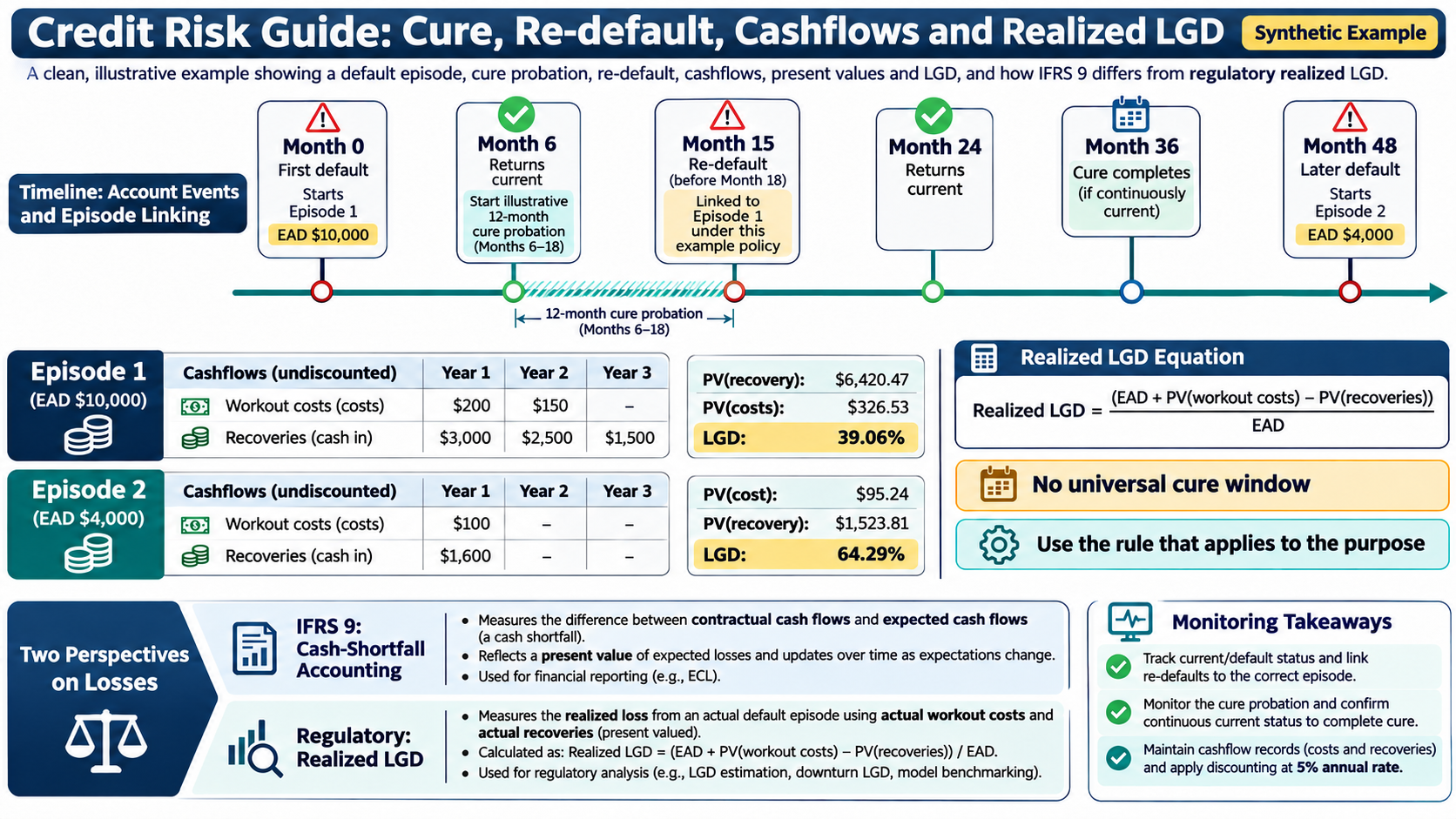
Work through how a cure definition and re-default linkage change episode-level LGD, recovery timing, and monitoring. The 12-month probation below is synthetic and illustrates one declared policy; it is not a universal or recommended cure window.
Key terms
Hover over or focus a term for a quick definition, or open its glossary entry.
Key definitions
- Cure means an account meets a stated return-to-performing rule and any required probation under the chosen methodology.
- Re-default is a later qualifying default; whether it belongs to a prior or new episode depends on the applicable rule and model design.
- Realized workout LGD compares exposure at a default date with discounted recoveries and relevant workout costs under a specified methodology.
PV(recoveries) = Σₜ Recoveryₜ / (1 + r)ᵗ
PV(workout costs) = Σₜ Costₜ / (1 + r)ᵗ
Illustrative realized LGD = (EAD₀ + PV(workout costs) − PV(recoveries)) / EAD₀
Redefault incidence by horizon H = eligible cured accounts re-defaulting within H ÷ cured accounts with full H follow-up
Worked example
Episode 1: EAD at Month 0 is $10,000. Discount recoveries of $3,000, $2,500, and $1,500 in years 1–3 and costs of $200 and $150 in years 1–2 at 5%. PV recoveries = $6,420.47; PV costs = $326.53; illustrative LGD = ($10,000 + $326.53 − $6,420.47)/$10,000 = 39.06%. A $1,600 recovery and $100 cost one year after a later Episode 2 default with EAD $4,000 give PV recovery $1,523.81, PV cost $95.24, and illustrative LGD 64.29%.
| Month | Event | Episode treatment in this example |
|---|---|---|
| 0 | First default; EAD $10,000 | Episode 1 begins. |
| 6 | Returns current | Illustrative 12-month probation begins, ending at Month 18 if status remains current. |
| 15 | Re-default before probation ends | Linked to Episode 1 by the declared example rule. |
| 24 | Returns current again | New illustrative probation runs through Month 36. |
| 36 | Still current | Cure completes in this synthetic example. |
| 48 | Later default; EAD $4,000 | Episode 2 begins under this declared example rule. |
| Episode | Default-date EAD | Cashflow timing | PV recovery | PV cost | Illustrative LGD |
|---|---|---|---|---|---|
| 1 | $10,000 | Recoveries $3,000 (Y1), $2,500 (Y2), $1,500 (Y3); costs $200 (Y1), $150 (Y2) | $6,420.47 | $326.53 | 39.06% |
| 2 | $4,000 | Recovery $1,600 (Y1); cost $100 (Y1) | $1,523.81 | $95.24 | 64.29% |
| Metric | Example definition | Key interpretation |
|---|---|---|
| Cure rate | Episodes meeting cure criteria ÷ mature eligible episodes | Denominator and probation policy must be fixed. |
| Re-default incidence | Re-defaults by horizon H ÷ cured accounts with full H follow-up | Do not treat accounts without full follow-up as non-redefaults. |
| Time to cure | Elapsed time from default to return and completed probation | Report distribution/percentiles, not just the average. |
| Recovery curve | Cumulative recovery and cost by months since default | Compare vintages and note unresolved workouts. |
| LGD O/E | Observed loss divided by expected loss for matched mature episodes | Review counts, mix, censoring, and policy changes before interpreting movement. |
WHY EPISODES NEED EXPLICIT RULES
A default episode is a governed grouping of delinquency, default, workout, cure, and potentially later re-default events used to measure losses. If event linkage is ambiguous, the same recovery can be counted twice, omitted, or attributed to the wrong exposure. State the unit of default, the cure trigger, any probation, what constitutes continuous performance, and whether re-default before probation completion remains linked to the original episode.
1. Fix the intended use
Identify whether the work supports IFRS 9 accounting, regulatory IRB LGD, stress testing, pricing, collections analytics, or internal monitoring. The word LGD does not make definitions or discounting interchangeable.
2. Declare an episode policy
In this teaching example, a return to current status begins a synthetic 12-month probation. A re-default before that period ends is kept in the current episode. A later default after a completed probation starts a new example episode. This is one transparent coding convention, not a universal rule.
3. Preserve an event timeline
Keep dated balances, arrears status, default flags, restructurings, cure dates, cash recoveries, collateral proceeds, and workout costs. Keep each raw event before applying episode transformations so a reviewer can reproduce the classification.
WORKED TIMELINE
Month 0 is the first default (Episode 1, EAD $10,000). The account returns to current at Month 6 and begins the illustrative probation through Month 18. A re-default at Month 15 happens before probation completion, so this example links it to Episode 1. The account returns to current again at Month 24; if it then stays current through Month 36, the example marks cure complete. A new default at Month 48 starts Episode 2 with EAD $4,000. Change the policy and this event path may be classified differently.
DISCOUNT CASH FLOWS TO THE DEFAULT DATE
For the simplified realized-LGD illustration, discount each recovery and qualifying cost back to its episode's default date. Do not net cashflows in nominal terms first and ignore timing. Episode 1 receives synthetic recoveries at year ends 1, 2, and 3, and incurs costs in years 1 and 2. The calculation gives PV(recoveries) $6,420.47 and PV(costs) $326.53. Subtract recoveries from EAD plus costs, then divide by default-date EAD: 39.06%. Episode 2 uses its own default date and EAD; its example result is 64.29%. Values are rounded to cents and percentages.
ACCOUNTING AND PRUDENTIAL METHODS ARE DIFFERENT
For IFRS 9, expected credit losses reflect probability-weighted contractual cash shortfalls, time value of money, and reasonable and supportable information under the standard. The applicable effective-interest-rate discounting and cashflow assumptions matter. The realized-LGD arithmetic above is not itself an IFRS 9 ECL calculation: it uses a single realized episode, a simplified flat discount rate, and fixed EAD.
For regulatory IRB LGD, use the applicable prudential definitions and supervisory guidance. EBA-GL-2017-16 includes specific treatment for realized LGD for cured exposures and subsequent defaults, with conditions in its paragraphs 135–136. That is a regulatory context and must not be generalized to every IFRS 9 estimate or internal analytics question. Basel framework data expectations also call for recovery timing and cost information.
Internal risk measures can define their own episode cohorts for forecasting or monitoring, but must label the convention, test alternative cure windows and episode rules, and keep it distinct from accounting and regulatory outputs.
MONITORING: DO NOT STOP AT ONE LGD
1. Cure rate
Eligible default episodes meeting the policy's cure criteria ÷ mature eligible episodes. Define whether the denominator is accounts, facilities, or episodes.
2. Re-default incidence
Re-defaults within a fixed horizon after cure ÷ cured accounts with full observation of that horizon. Exclude or explicitly model right-censored accounts that have not completed follow-up.
3. Time to cure
Track the distribution from default to return-to-performing and to completed probation; median alone can hide a long tail.
4. Recovery and cost curves
Compare cumulative discounted and undiscounted recoveries and costs at months-on-book from default, by vintage and segment.
5. LGD observed-to-expected
Compare realized and forecast loss on matched, mature episodes, while reporting sample counts, unresolved cases, mix, and uncertainty.
6. Episode quality
Monitor missing event dates, duplicate or negative cashflows, inconsistent EADs, re-default links, and episodes without a clear close or censoring status.
7. Segmentation and change
Review product, collateral, seniority, geography, collections path, and policy changes. A change in cure policy can shift measured LGD even if borrower risk has not changed.
IMPLEMENTATION STEPS
1. Build the dated event table
Keep one row per governed exposure event and retain source dates.
2. Apply the episode state machine
Store policy version, cure completion, and episode identifiers.
3. Link the cashflows
Attach each recovery and cost once to the correct episode, with source and cash date.
4. Discount with the chosen method
Match the rate and time basis to the measurement purpose.
5. Handle open workouts
Keep unresolved outcomes open or model censoring instead of assuming that no later recovery will occur.
6. Validate event assignments
Review sample accounts and compare results under plausible alternative cure/probation definitions.
7. Publish with context
Include purpose, population, maturity, source date, policy version, and metric owner.
REFERENCES AND SCOPE
The IFRS Foundation source describes IFRS 9's impairment requirements; the EBA guideline is an EU prudential IRB source; the Basel framework is a regulatory capital source. Consult the authoritative text that applies to the institution and jurisdiction. All amounts and dates in this article are synthetic, for education only.
Try a reproducible Python example
These examples use synthetic inputs and run locally in a browser worker. Edit the code, run it, and compare its output with the published example.
Runnable Python · local in your browser
Link re-default episodes and calculate discounted LGD
Apply a declared synthetic 12-month cure probation and compute two episode LGDs from bounded cashflow lists.
Output
Run the code to see the output.
Runtime loads only after you press Run. Code runs in a separate browser worker with a 10-second limit and a 20,000-character output cap. Use synthetic examples only; browser execution is not a secure environment for secrets or sensitive records.
Assumptions
- The example uses a 12-month cure probation purely for instruction; institutions and frameworks can define cure differently.
- All synthetic cashflows are annual year-end amounts, discounted to each episode's default date at a flat illustrative 5%.
- The example episodes use constant EAD within each episode and ignore collateral allocation, taxes, post-write-off interest, and other framework-specific adjustments.
Limitations
- Cure windows, default definitions, and episode-linkage rules differ by purpose and jurisdiction; these examples are not prescriptive.
- Unresolved workouts have incomplete future recoveries and costs; treating them as final outcomes can bias LGD.
- Changing collection strategies, collateral mix, legal processes, or macro conditions can change both recovery amounts and timing.
References
- IFRS 9 Financial Instruments — IFRS Foundation
- Guidelines on PD estimation, LGD estimation and treatment of defaulted assets — European Banking Authority
- Guidelines on PD estimation, LGD estimation and treatment of defaulted assets (EBA-GL-2017-16) — European Banking Authority
- Basel Framework: IRB approach and credit-risk components — Basel Committee on Banking Supervision
- Guidance on credit risk and accounting for expected credit losses — Basel Committee on Banking Supervision
Educational material only. Methods and examples are simplified; state and validate the assumptions required for your use case.