Credit risk foundations
What credit risk measures
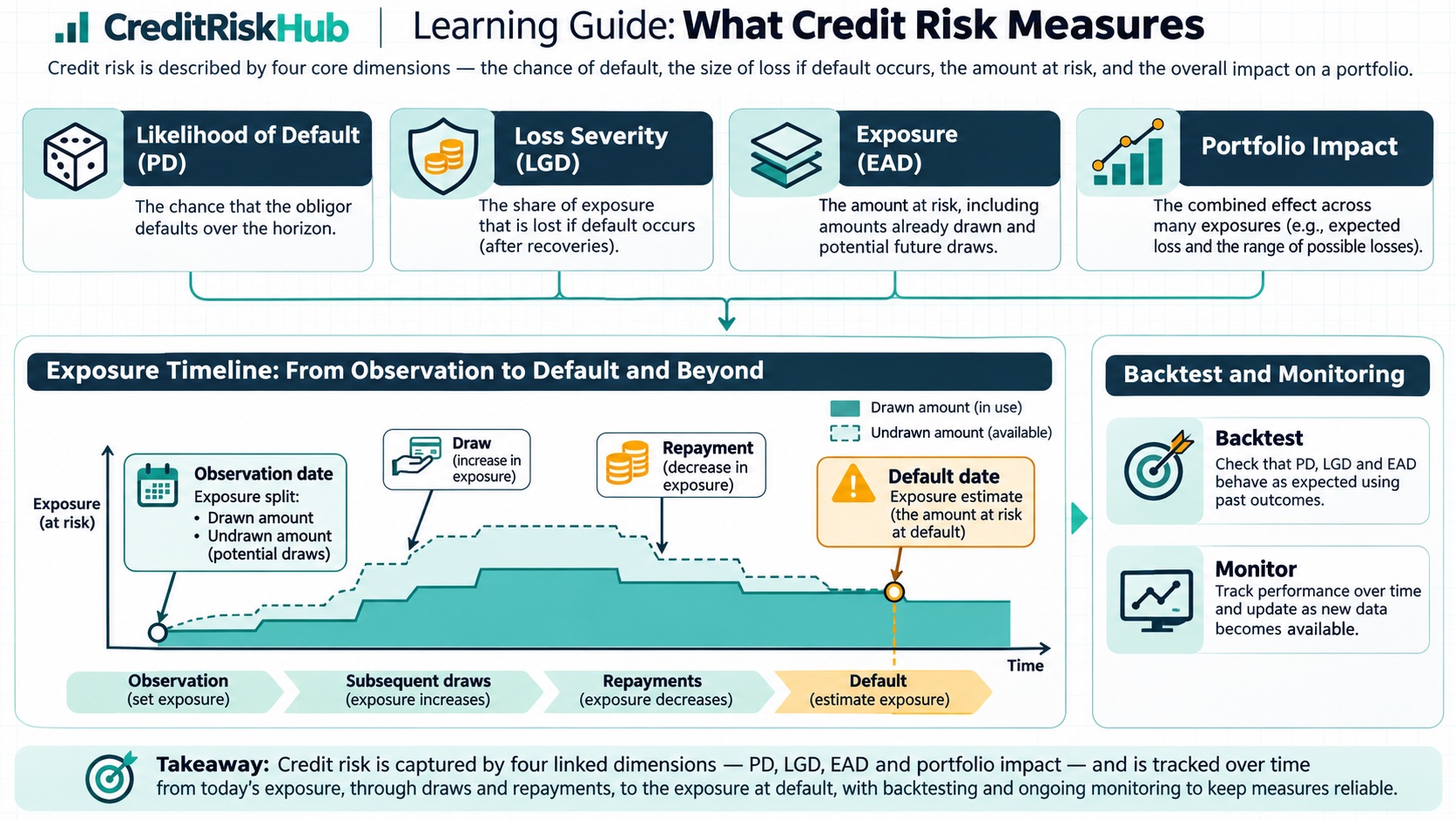
Separate likelihood of default, loss severity, exposure, and portfolio impact.
Purpose
Introduce the core dimensions used to describe credit risk and how they fit together.
Key terms
Hover over or focus a term for a quick definition, or open its glossary entry.
Key definitions
- Credit risk is the possibility that a borrower or counterparty fails to meet an obligation.
- PD describes default likelihood; LGD describes the loss fraction conditional on default; EAD describes exposure when default occurs.
Illustrative expected loss = PD × LGD × EAD.Worked example
For PD 2%, LGD 40%, and EAD $10,000, simplified expected loss is $80 for the stated horizon.
Detailed explanation
Credit risk is not a single number. A borrower can have low default likelihood but high loss severity, or a large exposure but strong collateral. Analysts therefore define the unit of analysis, horizon, default event, and loss measure before comparing results. PD, LGD, and EAD are useful because they describe different parts of a loss process. Their product is a compact expected-loss approximation, but it says nothing by itself about uncertainty, portfolio concentration, changing economic conditions, or accounting requirements.
Begin by naming the decision the measure supports: approval, pricing, limits, impairment, capital, or monitoring. The same account can require different populations and conventions for each purpose. Keep accounting expected credit loss separate from Basel regulatory capital estimates, and document every mapping between them.
Try a reproducible Python example
These examples use synthetic inputs and run locally in a browser worker. Edit the code, run it, and compare its output with the published example.
Runnable Python · local in your browser
Compare expected loss and uncertainty across two distributions
Calculate the probability-weighted mean, variance, and standard deviation for two fully synthetic loss distributions.
Output
Run the code to see the output.
Runtime loads only after you press Run. Code runs in a separate browser worker with a 10-second limit and a 20,000-character output cap. Use synthetic examples only; browser execution is not a secure environment for secrets or sensitive records.
Runnable Python · local in your browser
Calculate WOE and IV from grouped counts
Use synthetic good and bad counts for three ordered scorecard bins. The 0.5 adjustment avoids a zero distribution in this small example.
Output
Run the code to see the output.
Runtime loads only after you press Run. Code runs in a separate browser worker with a 10-second limit and a 20,000-character output cap. Use synthetic examples only; browser execution is not a secure environment for secrets or sensitive records.
Assumptions
- The simplified expected-loss relationship assumes parameters refer to a consistent exposure, population, and horizon.
Limitations
- This product is a teaching identity, not a complete IFRS 9 or capital calculation.
- Unexpected loss and portfolio dependence require additional analysis.
References
- Basel Framework: IRB approach and credit-risk components — Basel Committee on Banking Supervision
- Guidance on credit risk and accounting for expected credit losses — Basel Committee on Banking Supervision
Educational material only. Methods and examples are simplified; state and validate the assumptions required for your use case.