Credit risk foundations
Credit lifecycle and risk appetite
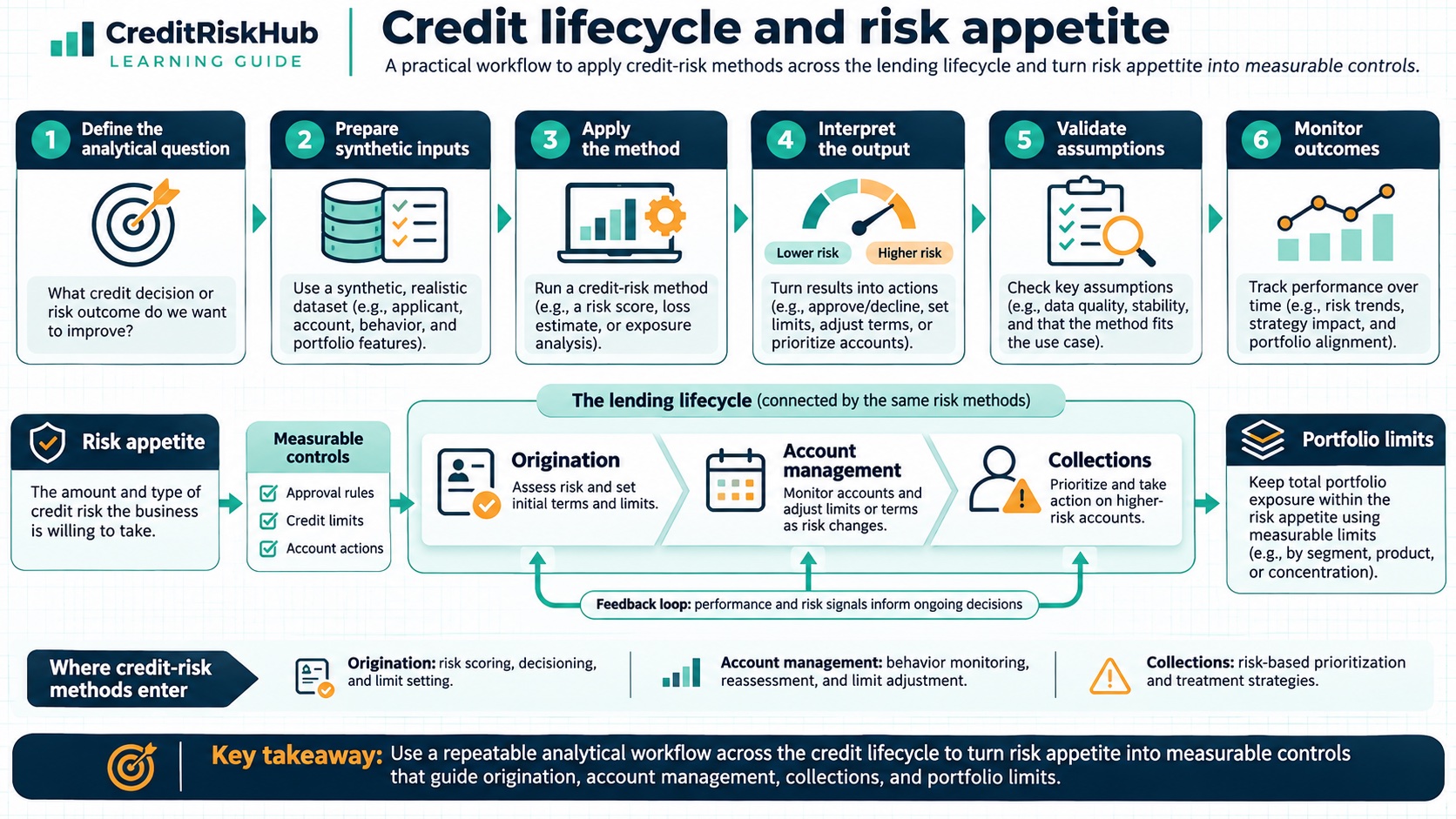
Connect origination decisions with account management, collections, and portfolio limits.
Purpose
Map where credit-risk methods enter the lending lifecycle and how appetite becomes measurable controls.
Key terms
Hover over or focus a term for a quick definition, or open its glossary entry.
Key definitions
- The lending lifecycle spans application, decision, booking, servicing, monitoring, collections, and closure.
- Risk appetite states the kinds and amount of risk an institution is prepared to accept.
Illustrative limit utilization = observed exposure ÷ approved exposure limit.Worked example
If a portfolio has $48 million exposure against a $60 million limit, utilization is 80%.
Detailed explanation
A score is only one input to a controlled decision process. At origination, policy may combine risk estimates, affordability, fraud controls, and product eligibility. After booking, behaviour, delinquency, utilization, hardship, and macro conditions can change the risk picture. Collections and restructuring data feed future performance measurement.
Risk appetite translates strategic boundaries into thresholds, limits, and responsibilities. For a useful metric, specify its population, numerator, denominator, data owner, review frequency, breach definition, and action. A metric with no escalation route is only descriptive. Appetite should also cover concentrations and operational constraints, not just average PD or approval rate.
Try a reproducible Python example
These examples use synthetic inputs and run locally in a browser worker. Edit the code, run it, and compare its output with the published example.
Runnable Python · local in your browser
Compare expected loss and uncertainty across two distributions
Calculate the probability-weighted mean, variance, and standard deviation for two fully synthetic loss distributions.
Output
Run the code to see the output.
Runtime loads only after you press Run. Code runs in a separate browser worker with a 10-second limit and a 20,000-character output cap. Use synthetic examples only; browser execution is not a secure environment for secrets or sensitive records.
Runnable Python · local in your browser
Calculate WOE and IV from grouped counts
Use synthetic good and bad counts for three ordered scorecard bins. The 0.5 adjustment avoids a zero distribution in this small example.
Output
Run the code to see the output.
Runtime loads only after you press Run. Code runs in a separate browser worker with a 10-second limit and a 20,000-character output cap. Use synthetic examples only; browser execution is not a secure environment for secrets or sensitive records.
Assumptions
- Appetite statements are translated into owned, monitored measures and escalation paths.
Limitations
- A single limit-utilization ratio cannot describe all risk dimensions.
- Risk appetite measures are institution-specific and need governance.
References
- Guidance on credit risk and accounting for expected credit losses — Basel Committee on Banking Supervision
- Guideline E-23: Model Risk Management — Office of the Superintendent of Financial Institutions Canada
Educational material only. Methods and examples are simplified; state and validate the assumptions required for your use case.