Credit-risk data engineering
Entity keys and source-system mapping
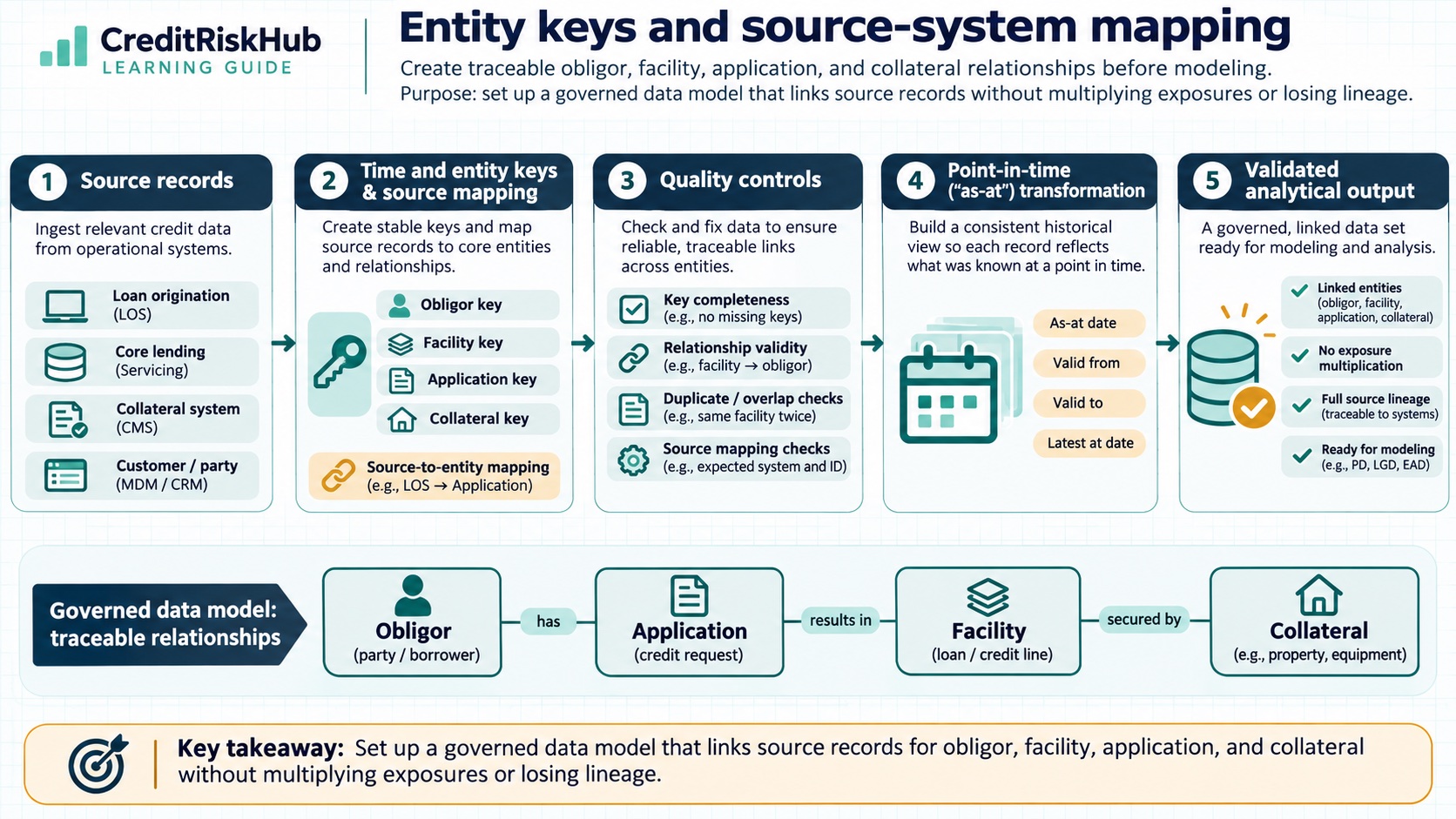
Create traceable obligor, facility, application, and collateral relationships before modeling.
Purpose
Set up a governed data model that links source records without multiplying exposures or losing lineage.
Key terms
Hover over or focus a term for a quick definition, or open its glossary entry.
Key definitions
Join invariant: output row count and key uniqueness match the declared analytical grain.Worked example
Before joining monthly balances to one borrower row, confirm whether the expected result is one row per borrower-month or facility-month.
Detailed explanation
Credit risk data often lives across origination, servicing, collections, bureau, collateral, and finance systems. Build a field dictionary that identifies source, business definition, grain, effective date, refresh cadence, and transformation. Preserve immutable source keys and map them through effective-dated crosswalks.
Test uniqueness and row counts before and after joins. A one-to-many relationship may be correct, but only if the downstream grain accounts for it. Reconcile balances and default flags to trusted control totals, retain data lineage, and version mapping rules so a score or ECL result can be reproduced later.
Try a reproducible Python example
These examples use synthetic inputs and run locally in a browser worker. Edit the code, run it, and compare its output with the published example.
Runnable Python · local in your browser
Detect a point-in-time feature leak
A miniature data preparation check compares each feature's observation date with the prediction date.
Output
Run the code to see the output.
Runtime loads only after you press Run. Code runs in a separate browser worker with a 10-second limit and a 20,000-character output cap. Use synthetic examples only; browser execution is not a secure environment for secrets or sensitive records.
Runnable Python · local in your browser
Engineer numeric credit-risk features
Use a training-only median, explicit missingness flags, a log transform, a payment-to-income ratio, and a delinquency indicator. Amounts are synthetic CAD; transforms are illustrative and should be validated for the intended population.
Output
Run the code to see the output.
Runtime loads only after you press Run. Code runs in a separate browser worker with a 10-second limit and a 20,000-character output cap. Use synthetic examples only; browser execution is not a secure environment for secrets or sensitive records.
Assumptions
- Crosswalk keys are effective-dated, reviewed, and retain source-system identifiers.
Limitations
- False merges or splits can corrupt default labels and exposure totals.
- Master-data rules can change over time and require versioning.
References
- pandas user guide — pandas documentation
- Guidance on credit risk and accounting for expected credit losses — Basel Committee on Banking Supervision
Educational material only. Methods and examples are simplified; state and validate the assumptions required for your use case.